
At Joy in Enough we believe that economics is far too important to leave to economists. At its heart it is about how we live together, how we organise work and leisure and resources. It matters to all of us, and so we should all be able to hold an opinion about it.
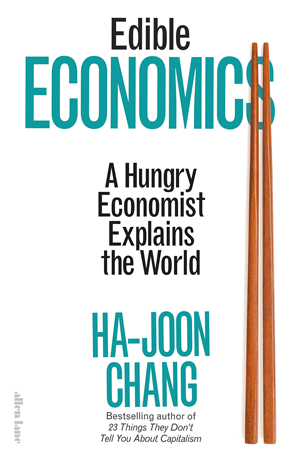
That’s something the economist Ha-Joon Chang argues too, in his book Edible Economics, which uses food as a way to explore economic theory. Each chapter picks a dish, looks at its history and culture, and uses it as a jumping off point to probe some economic assumptions: “I am trying to make economics more palatable by serving it with stories about food,” he writes.
Chapters are short and pick a food to introduce a topic. A discussion of how prawns are enjoyed in different ways in different countries raises the question of why people turn up their noses at eating insects. Which leads to the traditional Korean snack of silkworm pupae, and then into the importance of silk, and then how Japan went from being an exporter of silk to a high-tech industrial economy by nurturing and protecting its industries.
Chang is a foodie but not a snob, and like his economics, he appreciates a bit of everything. A comparison between Korean and Italian noodles leads to the story of a pasta shape developed by a car designer, to the evolution of Hyundai and the Korean car industry. Limes take us into a history of the British Navy’s battle against scurvy, and informs a discussion of governments’ role in climate change. Strawberries introduce the topic of worker rights, and then an assessment of AI as a threat to jobs.
The diversity of the chapters is part of the message: the most exciting chefs often fuse the best of different traditions, and it’s the same in economics. Use your imagination, and choose a varied diet of economic theory.
These excursions are often very creative. They felt to me like the result of many years musing things over at the kitchen counter while preparing food, or discussing the connections with friends and family over the dinner table. The book explains lots of useful and sometimes complex ideas in short and entertaining ways. It’s thoughtful, funny, and best read with a snack.
“When it comes to food, we all work out our own ways to source ingredients, combine and cook them and come up with new ideas” he writes. “It should be the same with economics. You don’t need other people to tell you how to learn, critically reflect upon, and use economics. You are all perfectly capable of figuring it out for yourself.”
Reading Edible Economics may indeed help you to figure out some things for yourself. Another way would be to get some friends together and run the Plenty! discussion course, which looks at topics such as inequality, climate change and consumerism across a series of sessions. It’s free to download and use, and it might just change the way you see the world.
 Joy in Enough