

Catherine Masterman considers the plastic habits of children’s craft.
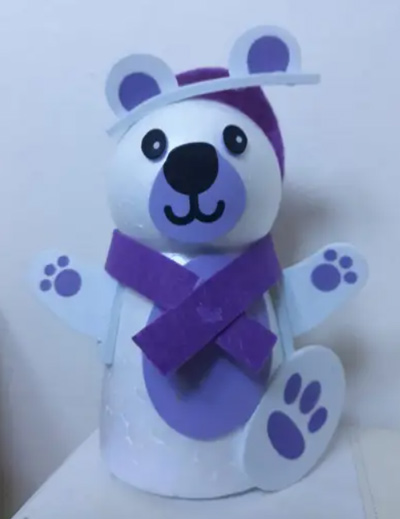
As a mum of two girls, my house has been bombarded over the years by single use plastic in the name of ‘craft’. This polar bear took five minutes to make. It was displayed for five days. Once it reaches landfill it would take 500 years to decompose.
It’s easy to see and interact with the materials in front of us, without thinking about what had to happen for them to be in front of you, or what will happen to them after they outlive your use for them. The parts of this bear would have begun as a fossil fuel derivative, turned into polystyrene, in a factory most likely to have been powered by coal. It would have then been shipped across the globe to a warehouse in the UK, before being couriered to the school. Once constructed, it was brought home to clutter an untidy house with the emotional baggage of ‘look what I made’, with the accompanying guilt that throwing it away would contribute to landfill. That guilt could sustain its presence in my house for a number of years, but it doesn’t change its destination.
“Five minutes to make; Five days to display; Five centuries to decompose.
Craft doesn’t feature highly in many lists of ways to reduce your environmental impact. But the point isn’t reducing the total carbon and plastic footprint of the craft industry. It matters because craft has a key role in building norms, expectations and assumptions of our children about the way in which they interact with ‘stuff’. At a time when tackling plastic pollution is the subject of discussions on a global treaty, it is high time we looked at how to tackle the expectations that perpetuate a ‘disposable’ view of the world, and, in doing so, look at the way in which over-reliance on single use plastic in craft is even at odds with the very reason for doing craft in the first place.
Why do craft and what’s wrong with plastic?
Arts and crafts play a critical role in our children’s experience of educational settings, for reasons well-argued by many early years’ specialists. Beyond the evident benefit of ‘keeping them occupied’, craft fosters and releases creativity, it helps develop fine motor and literacy skills and contributes to emotional well-being, confidence, resilience and self-esteem. In a church setting it helps to reinforce stories and ideas from the Bible, particularly the way in which we all express the creative aspect of God’s nature. The question is whether plastic helps or hinders these aims.
Looking at the benefits of craft, identikit assembly tasks might help fine motor skills and the ability to follow instructions but rarely deserve the label of “fostering creativity” or “developing imagination’. My two daughters are as alike and as different in character as any normal siblings. The day they came home with two identical polar bears, the whole vitality and energy of all their differences in approach to life was reduced to the choice of light blue over purple. Rather than fostering resilience, pre-cut craft materials can encourage near instant gratification through minimal effort to produce something that readily resembles the picture on the packet. And rather than time spent on ‘craft’ to teach a genuine skill that could produce something worthy of lasting display, we end up praising our children and cluttering our houses for little more than rapidly constructed rubbish.
Then there is the way in which plastic in craft reinforces the disconnection with the natural world that is the heart of the ecological challenges we face. For children, the bright colours, attractive faces and consistent texture are familiar and comfortable – many of their most popular onscreen characters could be happily be transposed onto craft foam, and have as little locus in a real, natural setting. By making the monochrome, the neon and the plastic the default materials we reinforce the message that ‘normal’ external surroundings are artificial and synthetic. Children will rarely ask anything about the origin of a pre-made kit, or pre-made materials because it does not occur to them that it must have come from somewhere. In contrast, there is research that suggests that by using natural materials, children are much more likely to ask about the origin. The materials of their play and craft become a gateway to learning more about the natural world, with all the benefits that brings – from literacy to improved emotional well-being, benefits that are increasingly well documented.
It takes a deliberate shift in perspective to see single-use plastic craft, not as the cheap and convenient solution in all childcare settings, but essentially as a piece of fossil fuelled rubbish, going to landfill via a child’s mind and shelf. When my eldest daughter was small, I did not think this way. I thought only of her entertainment and my convenience. I bought plastic flowers shapes in plastic boxes and readily ordered glittery foam stickers for church activities in a way I wouldn’t countenance now.
Plastic craft is not the cheap and convenient solution in all settings, but essentially a piece of fossil fuelled rubbish, going to landfill via a child’s mind and shelf.
If what it puts in their mind and contributes to their development, and the world in which they will grow up, is not only not worth the cost, but is in fact counter-productive, it’s time to think again.
The challenge of making the shift…
Most people currently working with children face significant constraints on their time and budget. They need additional considerations to take into account in their planning like a proverbial hole in the head. There are real advantages from the pre-cut plastic. It comes in sufficient numbers to give everyone the same thing, it’s cheap, it’s verified as safe, the children like it, it can be stored without disintegration and it is relatively unscathed by the normal ravages of small-child handling. Even if you want to make the shift away, how do you overcome those challenges? There is little to be gained by shipping packets of pebbles and shells across the world. To be authentic and gain the maximum benefit, using natural materials means finding things out and about, or sourcing from somewhere nearby.
And my experiences of the attempt
Providing activities for a playgroup and nascent Sunday school for the last two years has given me some insight into the challenges and potential solutions, but I am sharing these with the caveat that I am well aware that I have been providing for fewer children than most childcare settings. My overall sense is that it is better for more schools and churches to make partial and imperfect attempts to reduce single use plastic, than for a very few institutions to eliminate it immediately and entirely. Looking at the materials in a different way, and then making the shift for one activity, or one product is a start, and then the benefits and incentives will become more evident over time.
The first time you use a particular material it takes effort to find it. My children are now used to Sunday afternoon walks with an additional dimension of collecting particular pine cones, or other materials for my Monday morning playgroups. To start with, I did have an element of anxiety in not knowing if you will be able to find it or find enough. However, what I have learnt is that once you find a source of what you need, it will be there in abundance – far beyond a whole schools’ worth should you so need. And, at absolutely no financial cost. Not only that, it will be there again the following year. I have no training at all in either ecology or forest education, so for me, it was a learning experience first to find an alder tree, and discover what it produces, from which I could make these brilliant bees. Every time I walk past them now, or see one, I will think “that is an alder tree”. My life is richer as a result. And everyone loved the bees.
Children love doing the gathering of the materials, and even a scrubby edge of a playground can yield useful elements. However, if you are with the children, you do need to know what you need will be there – I rashly assumed that the catkins in huge abundance throughout our village would be in evidence near the churchyard and ended up legging it a hundred yards up the hill to find what we needed for lamb tails! And who knew that the woodland where our playgroup is would be the only group of trees that didn’t produce pine cones the week we went out to find some. If you can integrate gathering into the session, you can always keep what you find for craft another time.
There are a couple of hang-ups about the way we do craft that I wonder if they come more from grown-ups than the children. One is the ‘newness’ of what they use. Children don’t seem fussed about scrunching up or cutting out shapes from paper that’s already been cut as long as it turns into what they need. In church settings, childrens leaders want materials to look ‘nice’ to convey the message that the children are worthy of decent provision and are valued. But that message needs to be set alongside living out the value of minimising our resource consumption. The other is whether they always need or want to take it home – they may have enjoyed the process of doing it but are not necessarily bothered about keeping it. The more we see craft materials like ‘lego’ – pieces to put together for a particular purpose – but then disassemble for the next time they are needed, the less absolute volume of ‘stuff’ we consume. Googly eyes, pipe cleaners, lollipop sticks, all happily unstick and go back into a box.
Finally, as ever, we all have to take a step back to work out what the real purpose is of the activity. One of our best experiences of Sunday school was at a church that rarely provided anything for the children to ‘do’ beyond a colouring sheet. And yet, week on week it kept them engaged, they took it home, it reminded them of the story. Developing fine motor skills doesn’t need to end up in a ‘thing’. Sewing cards and shoelaces, duplo and construction blocks or straws, paper weaving, pasta pictures, peg boards, all provide ways to teach the skills without generating ‘stuff’. Our dependency on the cheap and easy availability of single use plastic craft is ultimately a choice – a choice that has an impact on what children consider ‘normal’. Even if it is done gradually, we can choose to change that.
For resources on where to find ideas, approaches and tips, please see:
Mud and Bloom (3-7s)
Little Pine Learners
Church of England resources on outdoor worship including craft ideas.
- First published on the Grain of Sand blog, used with permission.
 Joy in Enough