
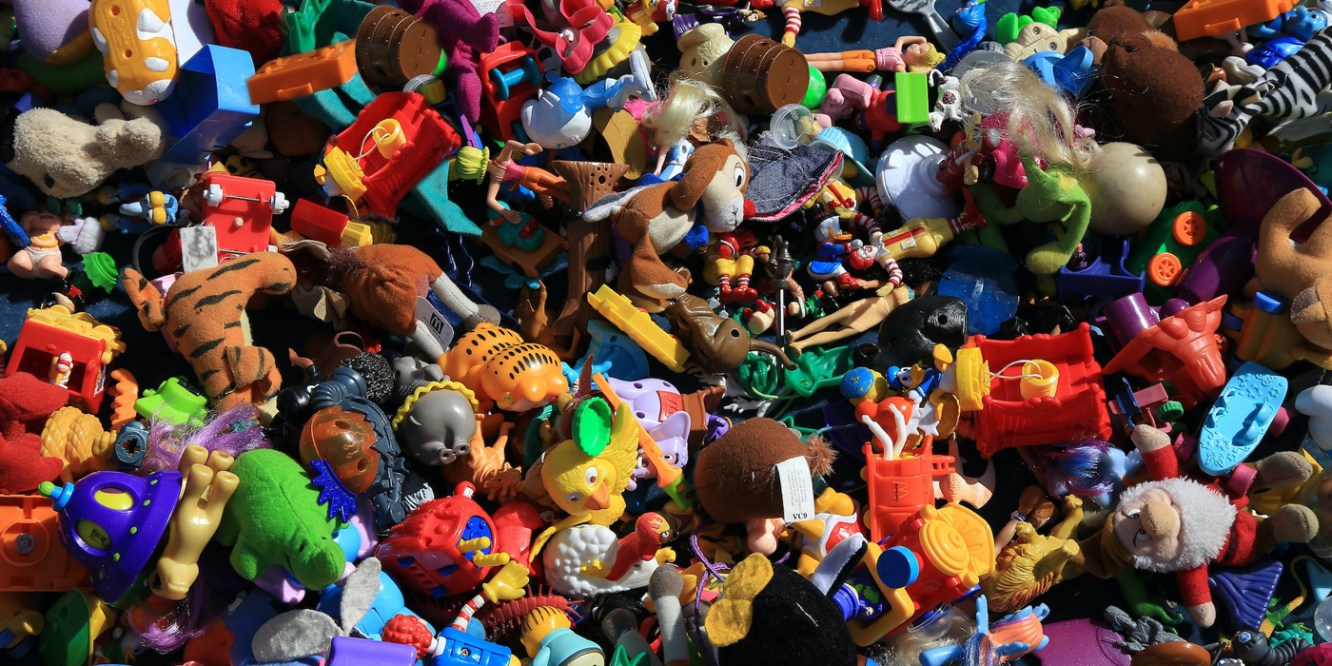
Many a parent has stood in the doorway of a child’s bedroom and wondered how it came to this. Toys spilling from boxes, drawers. Components of this mixed with elements of that. Broken things, ignored things. Too many things. How many toys do children need anyway?
I raise the question because I once read that the average ten year old has 238 toys. Parents tend to spend £350 pounds a year on toys for each child. Grandparents and friends add another £300 a year, so that by the age of ten children have £7,000 worth of toys.
And yet, parents estimate that their children have a pool of around 12 toys that they’ll play with most days. That’s about 5%.
As James Wallman points out, if you skipped the ignored 95% you could save £10,000 on toys by the time a child reaches 16, and put it towards something more interesting and worthwhile.
You’d also save an awful lot of resources. There’s something particularly tragic about the waste involved in toys that are never played with. There’s the waste of money and of materials. There’s also the waste of someone’s time in making it. That person was almost certainly working for very low pay and in poor conditions, because that is endemic in the industry – a structural injustice deeply buried in the layers of glossy packaging and primary coloured plastic.
Children like toys, of course. It’s nice to have plenty of choices, and of course not everything is going to get used every day. Some games are going to be reserved for the weekend or special occasions. Others have a novelty factor that wears off after a couple of hours. With some toys all the fun is in putting it together – here’s looking at you Scalextric – and then it’s just a tripping hazard for the next couple of days.
We can’t expect to only own the favourites. There’s always going to be a cupboard with puzzles, or beads, or overly elaborate sets of things that need adult participation. But there is a problem when it gets too much. As well as the wasted money, there’s the clutter, and the challenge of storing it all.

There’s also the psychological effect. Is it healthy for children to grow up with everything they want? How will children learn to value what they have and look after it? And it makes excess normal. Children who have too much stuff are likely to grow up to be adults with too much stuff, and that’s not good for our wellbeing or for the environment. It all plays into a consumer narrative that encourages us to find our worth in our possessions, rather than knowing ourselves as uniquely loved for who we are, as humans in the image of God.
Part of the problem is that, as mentioned above, parents are only doing half the toy buying. Hundreds of pounds worth is coming in from others, with perhaps little control over what it is and how appropriate it might be. We don’t come anywhere near those averages ourselves, but we still get often presents on birthdays and Christmas that I know will be languishing in a box within days, never to be played with again. Or at least, until I put it in a bag to take to the charity shop, and then it becomes the most important thing in the world…
So one place to start is to brief family and friends, especially at birthday parties. That’s not always easy, and I’m aware that we’re pretty lucky on that front ourselves. We tend to phone each other in my family and check about what we’re going to give. I like to try and get presents that won’t become clutter, either because it’s edible, or an experience, or a one-off project. A lot of things get passed on and shared, and I have a sister who is adept and unsentimental about trading unwanted things on Ebay.
Back at home, here are a few other suggestions for reducing toy accumulation:
- Specialise along certain lines. Do they need wooden trains and plastic trains? Playmobil and Sylvanian families?
- Resist fad toys or tie-ins. Some of this is inescapable if everyone’s into it, but there’ll be another blockbuster along in a minute and all those action figures won’t be interesting any more.
- Something in, something out. I remember my Mum suggesting this at one point before Christmas. There was a great hue and cry, and I can’t recall if we ever carried it through. But some families insist that children choose one thing to give away for every new thing that arrives. Done with flexibility, it would a good way to teach children not to hoard, and to be generous.
- Avoid toys as rewards. Do things together instead, even if it’s just the promise of going to that park on the other side of town that we don’t get to so often.
- Don’t have everything out all the time. We rotate toys around fairly regularly, and they stay exciting that way.
Perhaps most powerfully, do it in community. Over-consumption is often tied into individualism, and so community approaches often disarm both together. Rather than every family negotiating its own compromises, see what possibilities arise when you look beyond one household.
For example, a family I know are fond of Lego and buy big and expensive sets to build together in the holidays. They then carefully dismantle them into plastic boxes and lend them to friends. The same set could go round four or five families, often those who could not afford them otherwise. I enjoy borrowing Lego from them, and I also appreciate what it teaches our children and theirs: that there is nothing wrong with having nice things – they’re a blessing! But good things are to be shared and not hoarded, and being open-handed with our possessions multiplies the joy that they bring.
Shared toy collections can provide novelty and variety without overloading any one family. It helps children to appreciate the value of shared objects and things held in common, and the importance of taking turns and taking care. Churches, which so often have families with small children visiting during the week, seem like really good places to host toy libraries.
What else are you doing to keep a sensible toy collection?
 Joy in Enough