

It’s a tough time to be young – job prospects are shaky. Higher education is expensive. Home-owning is a pipe dream for many. After decades of progress, young people are expected to be worse off than their parents. And looming over all of this is the threat of climate change. It’s hardly surprising that nearly a third of 16-24 year olds in Britain showed signs of depression, according to the Office for National Statistics, and that data is from before the pandemic.
Britain is a wealthy country, but we haven’t done a very good job of stewarding that prosperity for the long term. To the writers of the Old Testament, this would be a serious failing. The covenants made between God and the people are always set in a long term context. Rules to be passed on “to your children, and your children’s children”, in return for blessings that will repeat down the generations.
Equally, we have to live with the mistakes of those that have come before us. “The fathers have eaten sour grapes, and the children’s teeth are set on edge,” as Ezekiel colourfully puts it.
For us in the UK, there’s a store of sour grapes to come. Underfunded schools, unsustainable pension funding, and environmental decline are just three examples of the poorer future we are creating. We need to rediscover ways of talking about intergenerational justice.
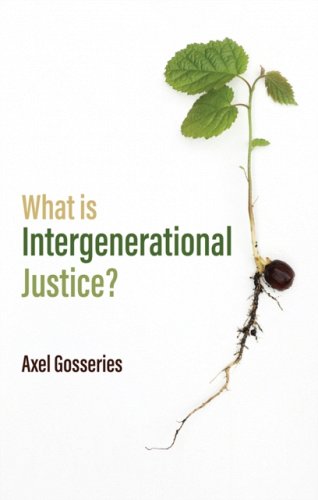
With that in mind, I recently read Axel Gosseries’ new book What is Intergenerational Justice? It outlines the philosophical questions around this topic, defining terms and addressing some key problems. What is a generation anyway? What do we owe the future? What happens when generations don’t overlap, and who speaks for the future? Is it even fair to think about our obligations to people who don’t exist yet, and are therefore only theoretical?
Gosseries addresses these questions as a secular philosopher, and one of the striking elements of the book is how few answers that perspective has to offer on this particular matter. It runs into dead-ends and complicated academic debates. It needs to outline precisely who has a duty to whom, and for what, and on what basis. What are our rights now, and their rights then, and how do they interact? The book successfully illuminates some complications when we start to try and apply intergenerational justice in the real world, but most of all it highlights how barren the intellectual toolbox looks when it comes to thinking about others.
In all the philosophical hand-wringing, what’s missing most is love. Love doesn’t ask what it is owed, what it gets in return. It doesn’t insist on its rights. It is all about looking beyond ourselves, and seeking the good of others.
Oli Mould has discussed this in his book Seven Ethics Against Capitalism. He describes the Greek words for love, which is a richer lexicon than our English one. Storge is the love for family, and has connotations of inter-generational wealth. That can be corrosive too however, and inherited wealth is a cause of ongoing inequality. For Mould, it is agape love that is transformative – the self-giving kind. “Agape thrives when something is given without any semblance of reward,” he writes. It is a love that “has no conditions, and as such has a radically generative power to create things that are entirely new.”
People know what this kind of love looks like, whether or not they share the Christian faith. They long for it. They are drawn to it. It needs no explanation (unlike many concepts of secular philosophy!) Shouldn’t we be more confident in talking about love as a motive for our politics?
As we think about what Christians can contribute to a fair and sustainable economy, shouldn’t love be at the heart of it?
When thinking about intergenerational justice, rights and duties don’t get us very far. But when we lovingly de-centre ourselves, the possibilities open up before us. If we let love motivate our actions, perhaps we can find the strength to heal the climate, address inequality, and invest in the future.
 Joy in Enough