

Shortly after getting the job generating content for this website, I was at a lunch for church and noticed this statement on a T-shirt worn by one of the volunteers serving the food: ‘JOY is an ACT of RESISTANCE’
The statement struck me between the eyes. Partly because of the new job I was starting, but mostly because it combined two concepts, ‘JOY’ and ‘RESISTANCE’, in a way that hadn’t occurred to me before.
How could Joy be an Act of Resistance? The phrase ‘act of resistance’ resonated with me because – in some ways – my life has been an act of resistance. I also have long been interested in the history of acts of resistance, particularly creative resistance, as means of standing up against oppression.
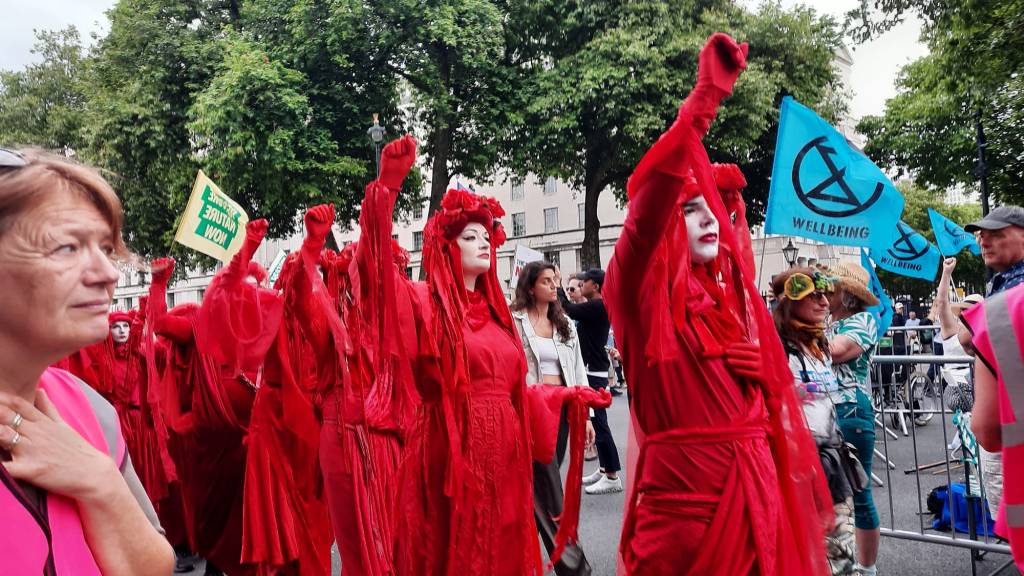
I see this creative and imaginative resistance in the best of what XR does, and outrider protest groups such as the Red Rebels. And I considered myself fortunate to be part of the Red Rebel Brigade at the RESTORE NATURE NOW march recently. Further back in history, the Civil Rights movement and suffragettes, have had creative approaches to civil resistance. Certainly I have experienced elation, as well as some fear and trepidation, whilst being involved in environmental protest.
Joy as an Act of Resistance though? This was new to me, an unfamiliar symbiosis of ideas.
As is the modern way, I quickly typed the phrase into a start page search on my phone, yielding interesting results:
The first thing that came up was that Joy as an Act of Resistance was the title of the second studio album by a band called the Idles.
I had never heard of the Idles before, but was interested to read that the singer Joe Talbot, had written of their most recent album:
‘This… is an attempt to be vulnerable to our audience and to encourage vulnerability; a brave naked smile in this shitty new world.’
Whilst reading about it, I particularly liked that the band had felt a massive pressure to write an album as good as, or as acclaimed as, their first. But because this made them feel bad about themselves, they junked the first set of songs and talked about why they weren’t enjoying making the album instead.
Isn’t it so often the case in the society we live in? So often we feel; 1) we can never fail (i.e. everything we do has to be successful) 2) we always need to be good enough, constantly meeting the same ‘standard’, or, worse, shooting for goal posts that seem to be constantly being moved. Of course – the influence of our upbringing can lead us to feel this way, but society needs to take a large portion of the blame too.
I think this is something we should talk about more and – like junking a project we aren’t enjoying and only doing to meet others’ expectation – do more often.
Are we here on this earth for Drudgery, or are we here for Joy?
Curious now, about this new band, I went on you tube to listen to some of the tracks on theJoy as an Act of Resistance album.
Straight away, a song called Danny Nedelko started playing. I say straight away, but first I had to sit through a YouTube served advert for flights featuring a car with a wig on. Sometimes to discover joy, you have to be willing to wade through the crud.
Then, almost as an epiphany, I encountered these amazing lyrics:
My blood brother is an immigrant
A beautiful immigrant
My blood brother’s Freddie Mercury
A Nigerian mother of three
He’s made of bones, he’s made of blood
He’s made of flesh, he’s made of love
He’s made of you, he’s made of me
Unity
They were certainly words that spoke to me, i.e. for me not to have a grudging tolerance of immigrants out of a sense of duty, but, instead, a joyful realisation and recognition of the beautiful diversity of the human race. (Danny Nedelko is a Ukrainian immigrant, and a friend of the band.)
The words seemed quasi-biblical. Reminding me of James1 and Romans 5. (And also Yoda.) Why do I struggle sometimes to be charitable to those different to myself?
Usually, I think because I fear them. And the fear I experience, I think, is the fear of difference, that those with a different background, identity and way of thinking to me may somehow take advantage of, or control or take something away me. It’s that natural fear – that of those different to myself – that those in power can seek to take advantage of. By attributing blame for all the ills of the country on immigrants, they distract attention away from blame owing to themselves. By keeping the populace in a state of fear of ‘The Other’ they create loyalty to themselves as those powerful enough to protect them.
This I realised (for myself) is why Joy is an Act of Resistance. Joy is an antidote to Fear. Joy finds and celebrates beauty in everything. Even where there is disagreement, its energy and life desires to overcome that disagreement, and to find common ground.
As an adolescent Christian with a melancholic disposition I found bible verses such as James 1:2 – ‘Consider it pure joy, my brothers and sisters, whenever you face trials of many kinds’ – difficult. I certainly didn’t want to experience trials of any kind, and being Joyful in the face of them, seemed like a kind of unreal masochism.
But just recently, I am coming to see that – if allowed – suffering and affliction can indeed lead mysteriously to Joy. I haven’t quite worked out why, but I think this has something to do with allowing one’s own suffering to develop compassion for others who are suffering. The stronger the affliction, the stronger the antidote. The greater the affliction, the stronger the immune response.
The RESTORE NATURE NOW march last Saturday sought to expose the degradation of nature, especially in the UK, where, if we want to enjoy the freedom of wild swimming, we have to risk the sewage overspills caused by a water industry too focused on profits and shareholder return, and not enough on maintaining clean waterways. Humans, especially rich Western humans, have degraded the natural world in many ways.
Yet for all that the world and its myriad peoples are still beautiful, and if we remain vulnerable may still inspire ‘a brave naked smile.’
Joy requires us to be vulnerable.
By Damian J. Hursey
Photo by Sheila Freeman
 Joy in Enough