

The Ministry for the Future
By Peter Grimwood
The Ministry for the Future was the title of a meeting I attended in Oxford on June 13th sponsored by Hertford College to launch their new project. The project is dedicated to seeking ways to address the environmental crisis and the need to develop a new sustainable political economy. There were a number of distinguished speakers, but I was excited by the prospect of hearing from Kate Raworth, author of Doughnut Economics and the American sci-fi novelist Kim Stanley Robinson whose novel, “The Ministry for the Future” clearly supplied the title of the meeting. I have just finished reading the novel.
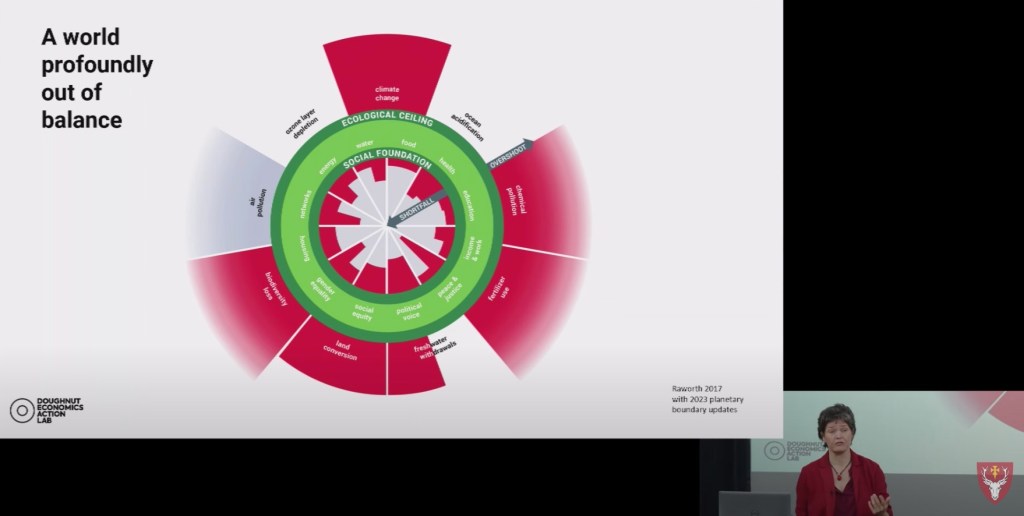
Kate explaining the Doughnut at the Hertford College event
The most striking aspect of Kate Raworth’s talk was her insistence that economics is not really a positive science, but rather a work of fiction.
You and I have been living within one particular work of fiction for most of our lives and it emphasises the role of markets, the “laws” of supply and demand that govern prices and the pursuit of gross domestic product (GDP) as an over-arching goal for national economies. Now, however, we need a new ‘fiction’ if we are to live within the Doughnut – a symbol Kate has developed to depict the problems of inequality and inequitable access to resources on the one hand, and the various forms ecological ‘overshoot’ on the other. To hear this from a professional economist was a moment of revelation!
A new fiction – she suggested – should no longer be focused on economic growth but instead on a new metric such as gross national happiness.
One might add joy in enough perhaps!
Then onto the podium stepped the American novelist Kim Stanley Robinson – the author not only of “The Ministry for the Future”, but also of “Aurora” an novel offering a model of spaceship earth.
I can’t recommend “The Ministry of the Future” enough to supporters of the Joy in Enough project.
It describes the establishment of a UN agency entitled “The Ministry for the Future” and the work it promotes to address the climate crisis and the opposition it encounters. It is set in the 2030s and 40s, and the principal characters are the Director of the Agency and her staff. The tone of the novel is optimistic – problems are overcome and opponents and critics are marginalised. A number of ingenious projects are initiated and their success is described. However at no point is a new fiction based on a theological standpoint offered by the agency to the public or to the readers of the novel. There are hints, no more, that Hinduism might have a contribution to make but alas that thought is not developed.
The novel is long (563 pages) but the effort involved I reading it was worthwhile and I can recommend it to Christian Greens with enthusiasm. A Christian response might well be to offer a supplementary or alternative vision of the future focused on God’s economy of grace or as we are accustomed to say “The Kingdom of God” for the coming of which we pray every day.
I congratulate Hertford College on this initiative and I hope there will be further open meetings in the future. The proceedings of the June 13th meeting can be viewed online.
Peter Grimwood
 Joy in Enough