
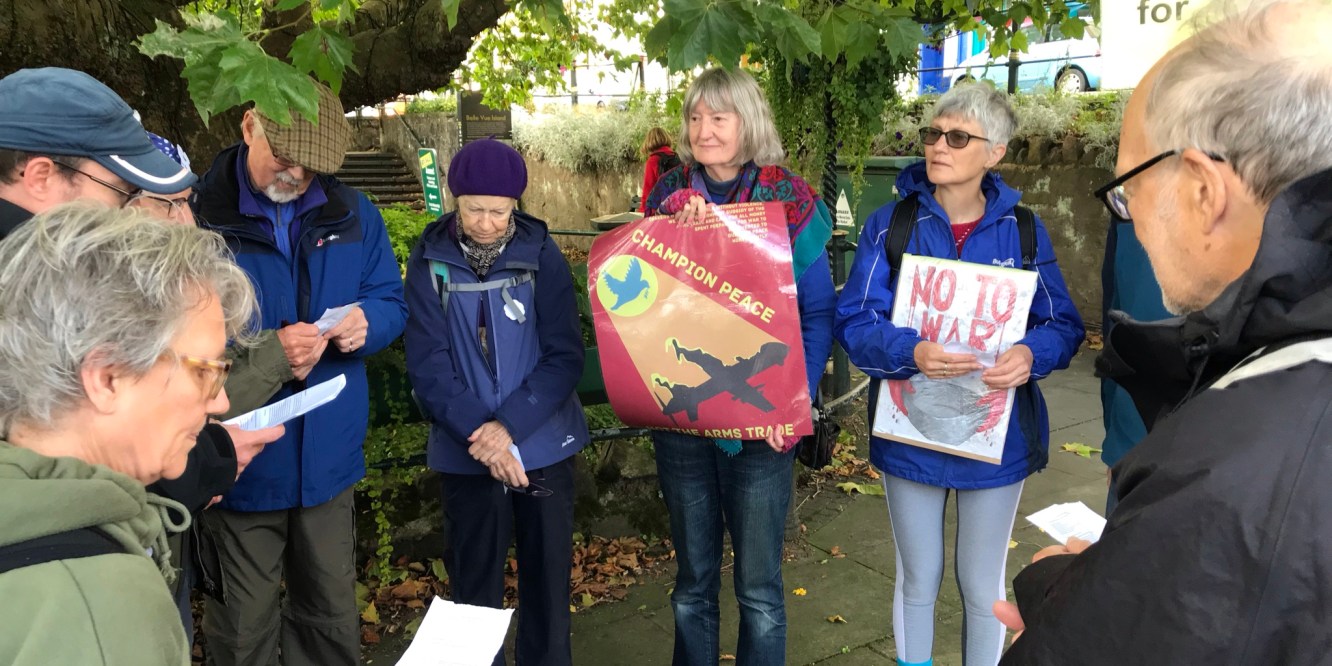
Back in September I walked part of a route from Malvern to Telford as part of a Peace Pilgrimage protesting the SDSC-UK arms fair. The fair was moving from Malvern to Telford, after being forced out of Malvern 3-Counties show ground by local activism – hence the route of the pilgrimage.
Since the start of the war in Ukraine, and more strongly since conflict in Gaza, I had felt a strong urge to walk or march for Peace, rather than in the name of any particular cause. This isn’t because I don’t support particular sides in the conflicts I’ve just named, but rather because I feel not enough emphasis is placed on the value of Peace, and what the intrusion of conflict means in the lives in of ordinary people caught up in wars through no fault of their own. Often it seems its the extremists on both sides that drive nations, or factions to war, but they are not ones most affected when conflict begins.
I remember near the start of the Ukraine war, Jeremy Corbyn, being pilloried for ‘supporting Russia’ in the conflict. But when I actually heard him being interviewed, he was saying something rather different, which was that he deplored Russian aggression, but he was concerned about the sabre-rattling that accompanied Western governments responses to Russia’s actions, and that not enough emphasis was being placed upon maintaining, or retaining peace.
So, when I heard about the Peace Pilgrimage between Malvern and Telford I felt it was very definitely something I wanted to be part of. An added attraction for me was we’d be walking through areas of the countryside I grew up near, which for my money are some of the most beautiful in the UK.
But why should a Peace Pilgrimage, and advocacy of Peace in general, be of interest to those interested in new economics and restoring nature? There are two reasons – firstly, War is environmentally catastrophic. Conflict in Gaza has been responsible by one estimate, of ‘planet-warming emissions… greater than the annual carbon footprint of more than 20 of the world’s most climate-vulnerable nations, new research reveals.’ Or 281000 metric tonnes in the first 60 days of the attack.’
Famously, the US military, for some reason, is not included the US tally of Carbon Emissions, as if its emissions somehow made their way on to another spiritual plane, into heaven, or some such place. As Benjamin Neimark, a senior lecturer at Queen Mary, University of London (QMUL) writes, ‘The military’s environmental exceptionalism allows them to pollute with impunity, as if the carbon emissions spitting from their tanks and fighter jets don’t count. This has to stop, to tackle the climate crisis we need accountability’
Secondly, and most importantly, from the point of view of the pilgrimage, is that the world’s arms trade, as a branch of the economy, has a vested interest in war happening, much as the world’s coffee industry has in us continuing to drink coffee. The difference being drinking coffee may, at worst, make people more irritable as a result of drinking it, where as war results in death, injury and human misery on a massive scale.
In 2022 the UK arms industry exports doubled to £8.5bn, and much of this was sent to authoritarian regimes designated as unfree by Freedom House, a human rights group.
In essence what justifies such a trade is a construction of ‘the Good’ that values the contribution to the economy made by the arms trade, and the security it is said to provide to the nation, over/against the Good of the value of peaceful relations between people, and the harms the sales of weapons may cause to them. But underpinning and intertwined with the latter construction, are the profits made by arms companies themselves, and the lobbying of politicians to award contracts to them as a form of corruption.
In other words, national security and industries that provide employment are good things, but we may wish to apply a ‘hermeneutic of suspicion’ ie. “a distinctively modern style of interpretation that circumvents obvious or self-evident meanings in order to draw out less visible and less flattering truths” – when we are told this the reason why a national arms industry should be supported to continue to exist, and further why these goods should trump the harms the arms industry obviously causes.
I would be lying if I said I found walking on the pilgrimage easy. Truth be told, walking long distances is not my strong suit, and by the third day I had developed such bad painful blisters I had to stop walking. However, needless to say my suffering paled into insignificance compared to those caught up in war, and as I returned home, having momentarily been deprived of some of them, I noticed I had a greater appreciation of the comforts afforded me by my western life style, and felt more grateful for the circumstances my life.
The SDSC-UK arms fair is happening in Telford next week from 18th-20th November. A protest is being organised here at the festival by CND for those that are interested in getting involved.
 Joy in Enough