

One of the key arguments for continued economic growth is the oft repeated Neoliberal Mantra, ‘A Rising Tide Lifts All Boats.’ In other words constant, continual, perpetual, relentless, rapacious, Economic Growth is good, and necessary, because even if those at the top benefit most, everyone ultimately benefits.
But how much benefit from growth to those at the top is acceptable compared to those in the middle and the bottom?
This and other extremely pertinent ethical questions are seldom discussed, mysteriously and magically passed over, as if by a sleight of hand.
The Global Inequality Project, however, was set up to shine a light on the answers to these sorts of questions, and drawing information from sources such as the United Nations, the World Inequality Database and the World Bank, has come up with some startling conclusions, that reveal the stark reality behind four decades of supposed shared prosperity.
The numbers expose a profound capture of collective gains – while global GDP has more than tripled – this explosion of wealth creation belies a very different story about where the benefits of wealth accrue.
It turns out that the top 1% have seized 54% of all additional output, while the richest 5% have claimed a staggering 70%.
This means that the overwhelming majority of everything we’ve produced—through our shared labor and the planet’s finite resources—has been hoovered upwards to enrich the already wealthy. The global workforce toiling in factories, mines, and agricultural operations that drive the world economy has received mere crumbs under the table of this feast of growth.
When examining wealth distribution rather than just income flows, the concentration becomes even more extreme. The wealthiest 1% control 42% of global wealth, with the top 5% commanding 69%.
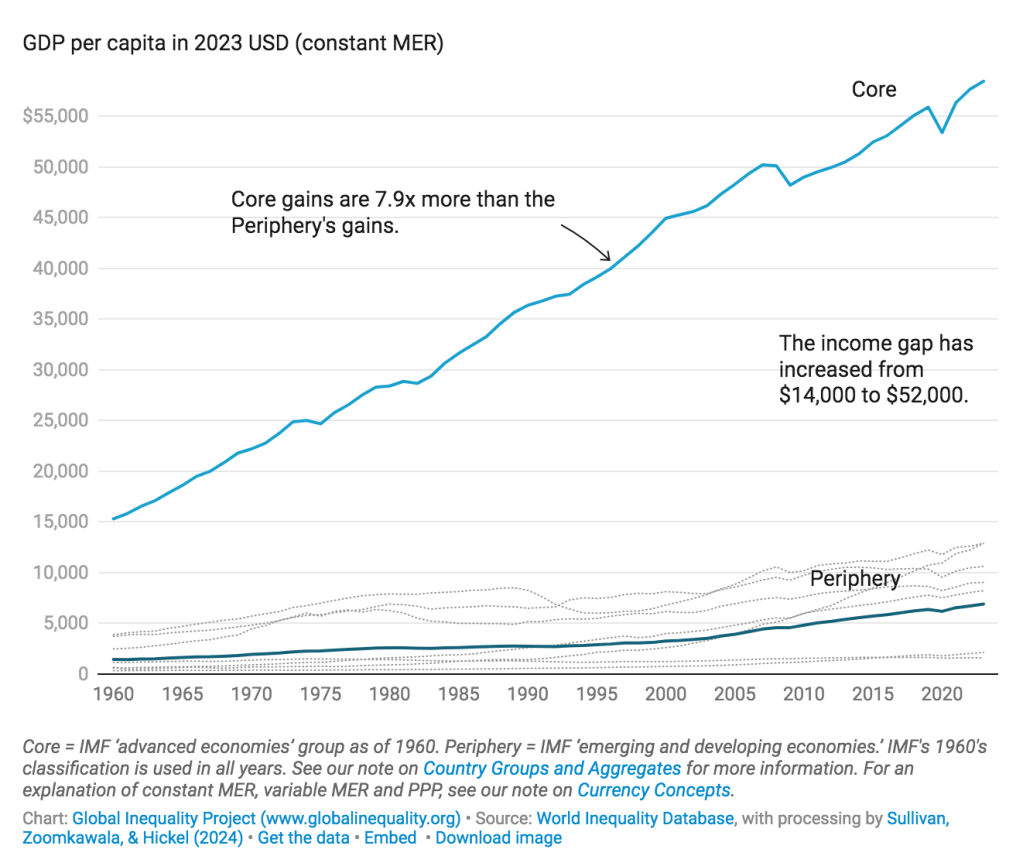
Meanwhile, half of humanity—billions of people—possess less than 1% of the world’s wealth. This isn’t merely about consumption patterns; it’s about who wields power over the fundamental engines of economic activity: land ownership, industrial capacity, financial institutions, and corporate control. Economic power remains anything but democratic, concentrated in remarkably few hands. Christians who take the words of Jesus about wealth, money and poverty seriously cannot see this state of affairs as acceptable
By Damian J. Hursey
 Joy in Enough