
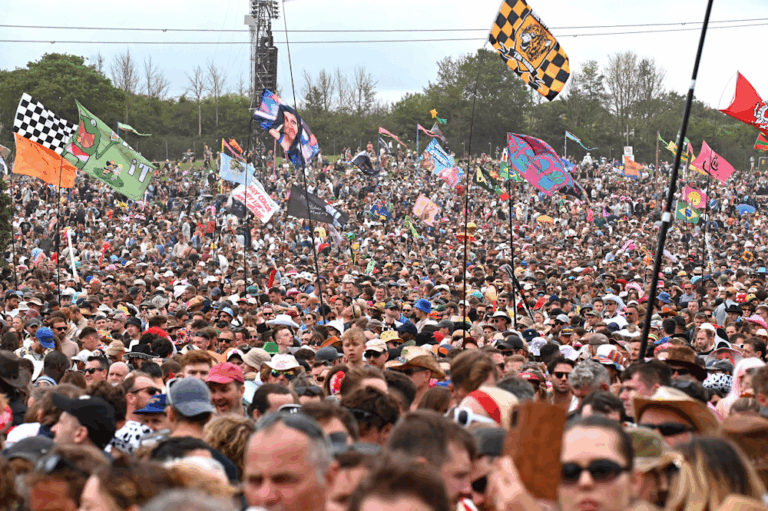
Glastonbury has been the subject of controversy this year, but something you may have missed is that recently the campaign group Money Rebellion (an offshoot of Extinction Rebellion that focuses on the financial dimension of environmental activism) has campaigned for Glastonbury festival to end their association with Allianz insurance, owing to them being the 6th largest insurer of fossil fuels globally.
MR point out that Glastonbury has a track record of ‘standing for justice, climate action, and international solidarity’ and that this is incompatible with being insured by a fossil fuel supporting company such as Allianz. An often overlooked fact is that the fossil fuels industry cannot operate without insurance for their pipelines, drilling rigs and refineries as well as for other liabilities. And the same insurance companies that insure fossil fuels are also those that insure festivals and also more every day things like houses. This makes them liable to boycott by consumers, and so possibly more pliable for consumer and citizen action.
An industry based upon the extraction of the substance the burning of which is the cause of Global Warming may not to be trusted to transition away from doing so. (The equivalent perhaps of Turkey producers voting to cancel Christmas.)
But – one would hope – the insurance industry would have more of an eye on future risk, if not for the sake of its own industry’s future (as more and more risks become uninsurable as the climate becomes more extreme) then upon the risk of insuring companies that are no longer risk worthy (as the companies become more subject to the risk of losses, becoming stranded assets, legal action etc)
Sadly, with certain exceptions such as Zurich, this does not yet appear generally to be the case. Major insurers like Chubb, Liberty Mutual and AIG continue providing essential backing to oil and gas, despite their public sustainability pledges. In the U.K., Lloyd’s of London, a key player in fossil fuel insurance, has actually weakened its climate policies – while most of its syndicates still support dirty energy projects. In the U.S., shockingly, insurers are actively backing massive new LNG terminals that will lock in decades of greenhouse gas emissions.
Yet a board member of the same Allianz under MR’s Glastonbury scrutiny has recently said in the New York Times that:
‘Climate change is simply making some things uninsurable.
“The math breaks down: the premiums required exceed what people or companies can pay,” he said. “This is already happening. Entire regions are becoming uninsurable.”
But the risks extend well beyond the insurance business, Thallinger said.
“This is not a one-off market adjustment,” he wrote in his post. “This is a systemic risk that threatens the very foundation of the financial sector. If insurance is no longer available, other financial services become unavailable too. A house that cannot be insured cannot be mortgaged. No bank will issue loans for uninsurable property. Credit markets freeze. This is a climate-induced credit crunch.”
At that point, Thallinger wrote, “the financial sector as we know it ceases to function.”
“And with it,” he added, “capitalism as we know it ceases to be viable.”
Whether this prospect is deemed good or bad one, Christian campaigners find themselves in a strange position where the insurance industry is both aware of the danger, yet continuing to be supportive of fossil fuels – fertile ground for the growing faith-based climate movement?
Campaigns like Insure Our Future are pressuring insurers to stop underwriting new fossil fuel projects and divest from coal, oil and gas. Christian Climate Action has brought prayer vigils to insurance company headquarters, while the Laudato Si’ Movement has mobilized hundreds of Catholic organizations to demand ethical finance practices. Churches are beginning to lead by example, moving their business away from insurers that fund climate destruction.
Perhaps real change in the insurance industry will require both moral courage and political will. We need laws mandating climate disclosures from insurers, stricter regulations on fossil fuel underwriting, and “Polluter Pays” legislation to hold the industry accountable. But perhaps most importantly, we need a fundamental shift in how we understand risk and responsibility.
The insurance industry was created to help society weather storms, not to profit from fueling them, through the pooling of risk. It was Edmund Halley (yes him of the comet fame) who first noticed that people of different ages died at different rates, and this could lead to an life insurance principle whereby those less likely to die could contribute to provision for those more likely to, by paying into a shared fund.
It’s important to see that there was a theological shift that underpinned this, whereby actuarial mathematics and statistical probability replaced to some extent the notion of Gods’ providence, in that it was insurance that was relied upon, rather than ‘there by the grace of God go I.’
This was in keeping with the 18th Century Enlightenment trend toward deism, where God’s action was conceived of working through these sorts of mechanisms, (such as Adam Smith’s ‘invisible hand’ where self-interested action led to mutual benefit in a providential way, ) rather than apart from them, at God’s discretion. Nonetheless a sense of mutuality, the common good and shared benefit were retained in the formation of these new ways of managing risks.
As Risks associated with Climate breakdown accumulate and increase, we may face again a situation where some risk, for example, that of houses near coasts and forests, are uninsurable.
By a terrible irony, if not hypocrisy, the same insurers responsible for insuring oil companies are already withdrawing coverage from climate-vulnerable areas, leaving families unprotected as storms and wildfires intensify even as they use home insurance premiums to invest in fossil fuel coverage.
In California and Florida, for example, millions have lost their insurance, with low-income communities bearing the brunt of this abandonment while Berkshire Hathaway, State Farm and others have actually increased their oil and gas investments in recent years. This climate betrayal runs deeper still when insurers take the premiums paid by homeowners and businesses and reinvest hundreds of billions into fossil fuel companies.
In the long term Christians may see an opportunity to trust more deeply in God if and when insurance fails us. In the short term, however, we can support actions such as those described above, and, for example, The Funeral for Nature in Birmingham tomorrow, collaborating with groups from across the Midlands – including Greenpeace, Birmingham Friends of the Earth, Brum Climate Justice Coalition, The Old Print Works and Coventry TUC, and targeting the offices of AXA, Howden, Allianz, and Hiscox, and imploring them to stop insuring new oil and gas projects.
Although not without risk themselves, these sorts of actions can bring us great joy, and unlike popular joy filled festivals are not insured by fossil fuel supporting companies.
By Damian J. Hursey
 Joy in Enough