

Part of Joy in Enough is the idea that the small things that spring up in nooks and crannies of society and illustrate a nicer, kinder way of living in the world have value, and are worthy of celebration.
In Candide, Voltaire famously recommended ‘tending to one’s garden‘ as a way of retreating from, and responding to, the world’s vicissitudes. In actual fact, however, could community gardening in urban settings be a radical response – and represent an alternative – to the consumer capitalist paradigm that promises so many rewards, but leaves environmental degradation, indebtedness, and inequality in its wake?
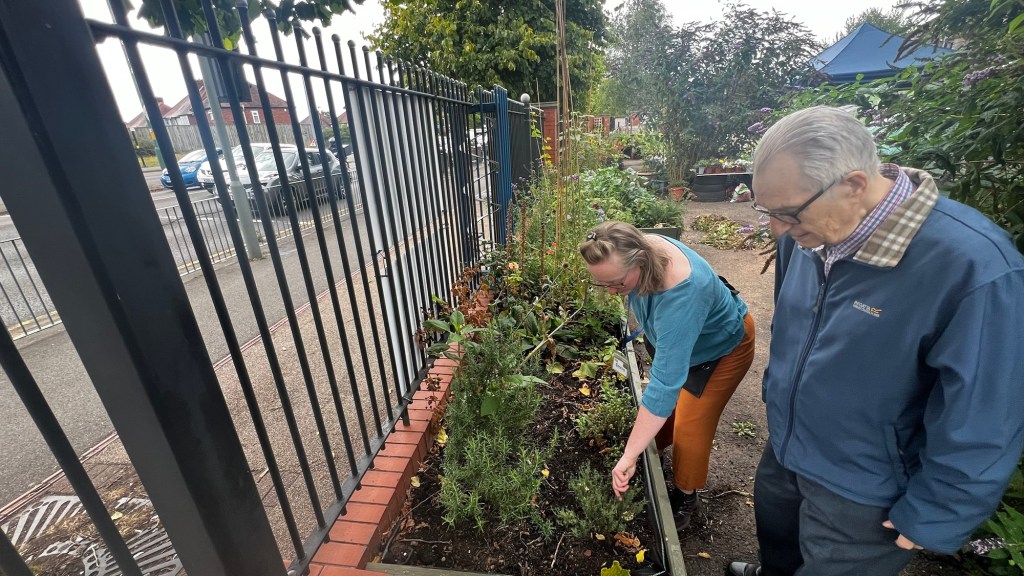
There are many such projects around the U.K but one I am familiar with is the Northfield Community Garden I visited with my father today. The project was founded by local activists from Northfield Arts Forum (NAF) in 2016, in a disused car park – right next to the A38 – one of the busiest and most polluted roads in Birmingham. I have been involved with Northfield Arts Forum since 2018, but even before becoming part of the community, I used to enjoy seeing the garden developing as I drove past, a bright beacon of beauty slap bang up against the bleak urban road intersection.
I asked social and therapeutic horticulturalists Anna O’Brien and Emma Waterford ( two members of NAF who organise activities at the garden) about what they thought the benefits were of being involved in the activities that run there.
Anna explained that the reason she liked being part of the project was that she felt everyone had a role to play – people who came ‘had different strengths and weaknesses, but when we’re feeling weak then we can cover each other’s weaknesses as well, and we feel much stronger working together!’
Anna explained that it was, ‘such a feel good factor to all know you’ve worked hard and produced something beautiful that gives joy to so many as they visit and walk past’
Emma, also an arts practitioner who specialises in working with people with mental impairment, agreed that it was, ‘a really lovely way to grow relationships and grow people alongside growing plants.’
But the benefits went beyond those of simply working together in shared endeavour. powerful though those were, as being in green space and outdoor spaces was inherently good for mental health – ‘if you’re able to Garden and if you’re able to get your hands in the soil it’s been shown there are microbes within the soil that can beneficially change your hormone levels and brain chemistry’, Emma explained.
This seems like a kind of natural ‘joy’ and reminded me of a talk by Johnathan Herbert who led Pilsdon community in Dorset – a refuge for recovering addicts – before becoming a long term community member at Hilfield Friary – a Peace, Justice and Environmental project I have mentioned before on this blog. Johnathan spoke of how working with the land – with the earth – somehow seemed to help recovering addicts in a way that other things didn’t. Perhaps we can infer from this, that in part, addictions of various kinds are due to unnatural urban environments, and loss of the natural ‘high’ that comes from being in and around and involved with nature.
Emma also stressed the way in which the garden provides solace from and partly counteracts the pollution coming from the road. Although only metres from the road they were working with willow and other tall bending plants to create a ‘bower of seclusion’ for people to come and relax in.

The skill sharing aspect of the garden was also important and the variety of projects in relatively small space of the car park (as was) was certainly impressive. These included a small poly-tunnel, whilst the manufacture of a rain water capturing device was still in progress.

polytunnel

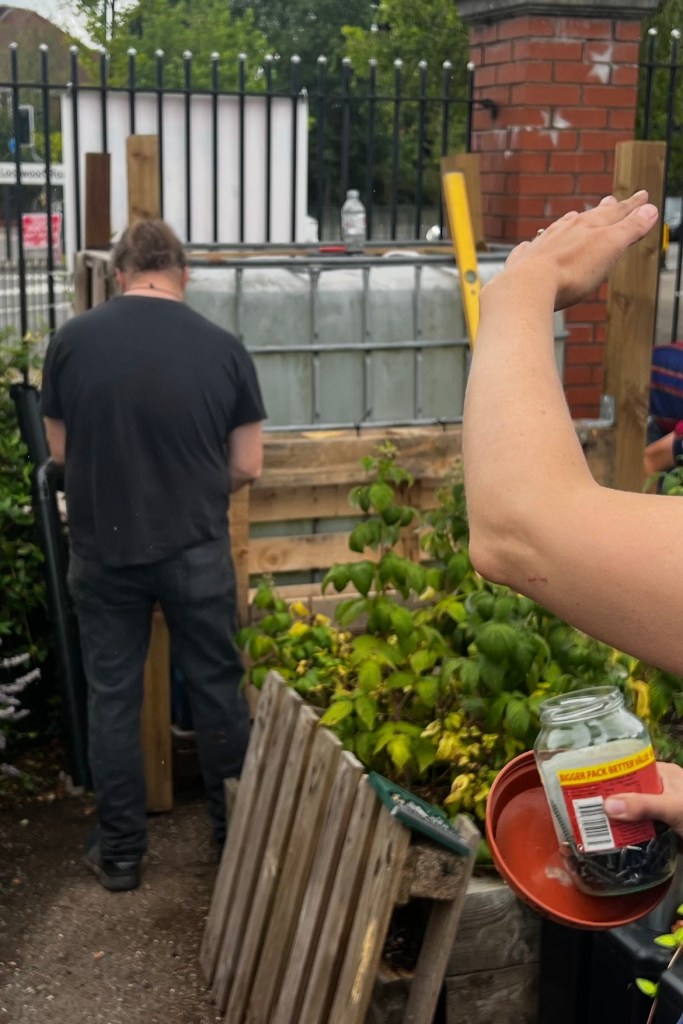
Building the skills and supporting skills development within the group was also important. so that every group members was able to lead their own workshops and teach the others what they knew – meaning the group ethos was very balanced and egalitarian.
In part this ethos was inspired by permaculture, Emma explained. I hadn’t realised, but permaculture is more than just a way of thinking about horticulture, but an entire ethos and way of life based upon nature cycles and nature rhythms. Within the philosophy of permaculture there is the idea of three intersecting circles fair share, earth care and care for each others.
The idea, it turns out, is to think about these three circles whenever you’re doing anything whether it’s gardening, running community projects, or just meeting people in the street.
Hence the session of the ‘Growing For Our Good’ project, dad and I attended combined the ideas of earth care and care for others, and was intended to be a therapeutic space for people with dementia that my father suffers from.

I can certainly attest to the positive effect on my dad who became very animated in the course of being shown round the garden and started talking in a rambling way about his own father and mother and their garden amongst other things.
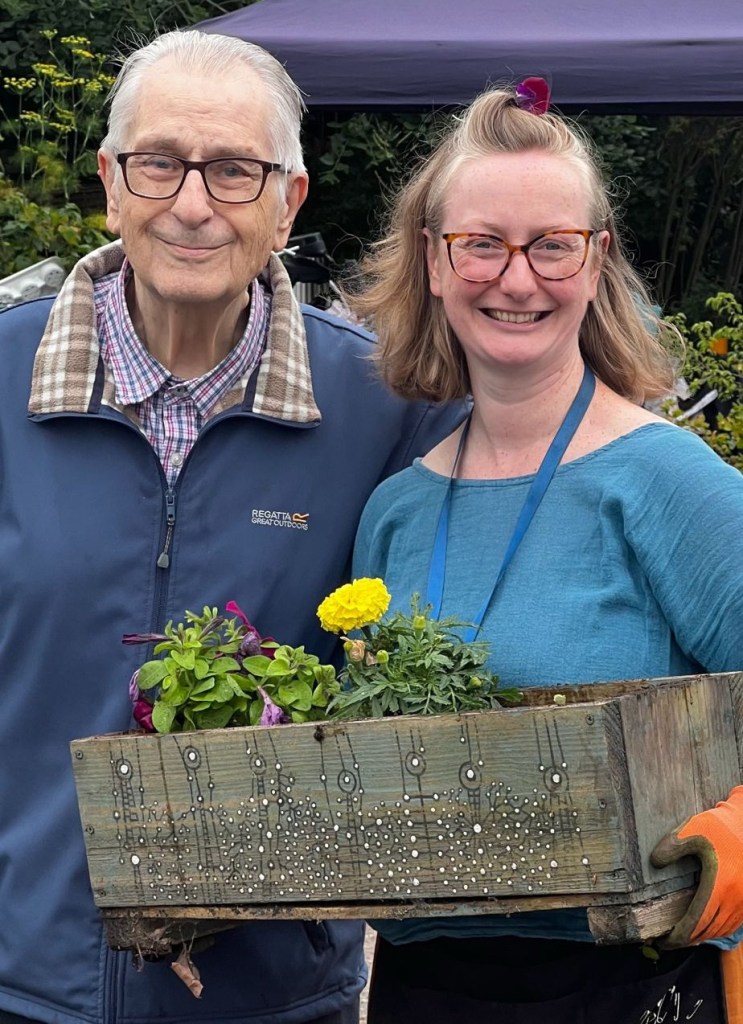
This must be the natural joy that people with mental limitations can manifest in the situations where many of us would struggle to let go of our anxieties and inhibitions and more of us need to experience to become free of the culture of consumer society. Perhaps if more of us tended to our gardens together in this way we might find ourselves moving in the right direction
 Joy in Enough