

In an age where so much of what we create is destined to be discarded, the idea of designing for disassembly offers the possibility of a quiet revolution. It’s a call to imagine products not as permanent, but as pictures in a process where materials can be reused, reimagined, and perhaps even returned to the earth without harm.

Such were the kind of sentiments designer Chloe Grant opened the second half of the afternoon of the Sustainable Fashion Forum I posted about last week, with a presentation on what it means to design not just aesthetically, but holistically and ethically.

Her focus on designing for disassembly challenged us to think beyond the life of a garment, to imagine how it might be taken apart and remade. Accordingly, Chloe explored the importance of using mono-materials, non-toxic dyes, and planet-friendly fabrics, while questioning the wastefulness of unnecessary embellishments that might look pretty but risked tiny microplastics infiltrating the environment
Ethical design, she reminded us, isn’t just about materials — it’s also about mindset. It’s about creating modular, repairable clothing, and reimagining business strategies that prioritise longevity over profit. Chloe’s words lingered with me – ‘Think as much about how something comes undone as you do about how it comes together.’
Zoe & Alex — The People’s Economics
Next, Zoe and Alex of the people’s economic foundation presentation peeled back the layers of the fashion industry to reveal the economic forces that shape it. Why do clothes cost what they do? Who benefits, and who bears the cost?
Their talk, The People’s Economics, traced how globalisation and mass production have driven prices down — but at the expense of both garment workers and environmental health.
Yet they also offered hope: cooperative economics, local supply chains, and conscious consumer choices can begin to tip the balance. By choosing how and where we spend our money, we can take back control of the economics of our wardrobes.
Every purchase, they said, is a small act of democracy.
Elle MacMillan — Weaving Futures: The Potential of Algae Bio-Yarn
Elle MacMillan then guided us into the realm of innovation — where science meets sustainability. Her work with algae bio-yarn paints a vision of fashion’s future rooted in nature’s own cycles.
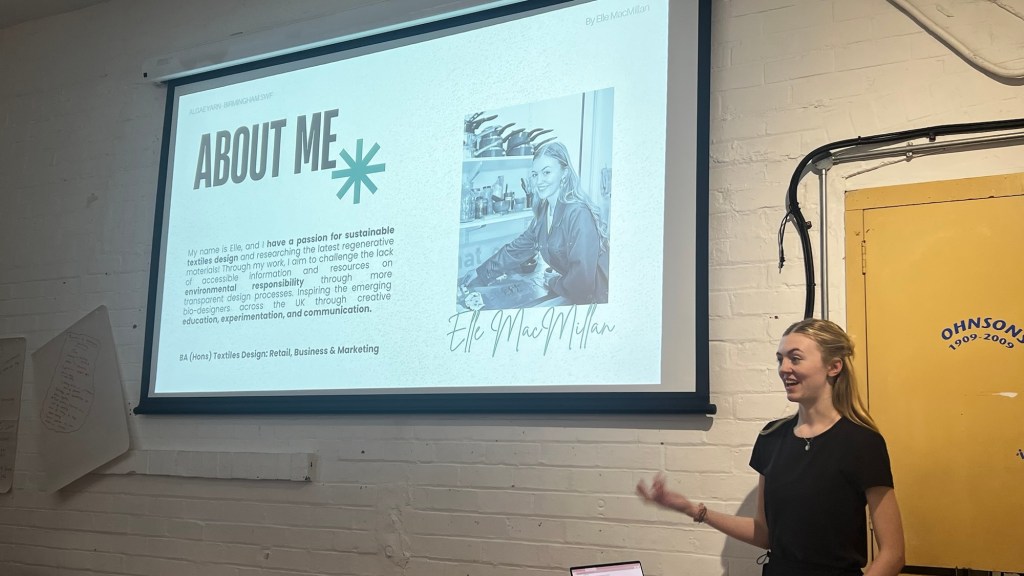
Unlike synthetic fibres, algae-based yarns are biodegradable, renewable, and can even help restore ecosystems. Elle’s research demonstrated how fashion might one day leave no trace — or better yet, enrich the planet it draws from. Surprisingly, it turns out that 90% of a garments reusability and environmental impact is decided at the design stage.

Her presentation reminded us that progress doesn’t have to mean pollution. Sometimes, the most forward-thinking ideas grow from the simplest, most ancient organisms.
Maya Patel — REINVNTD CIC: “Fashion, Reclaimed”
The day’s final speaker, Maya Patel of REINVNTD CIC, brought the focus back to the personal. Her talk, Fashion, Reclaimed, explored how what we wear expresses who we are — and how reclaiming our style can also mean reclaiming our values.
Rejecting fast fashion’s constant churn of trends, Maya encouraged us to embrace individuality, repair and reimagine old clothes, and take pride in secondhand.
Her message was joyful and defiant: when we make fashion our own, we break free from the systems that tell us to consume without thinking.
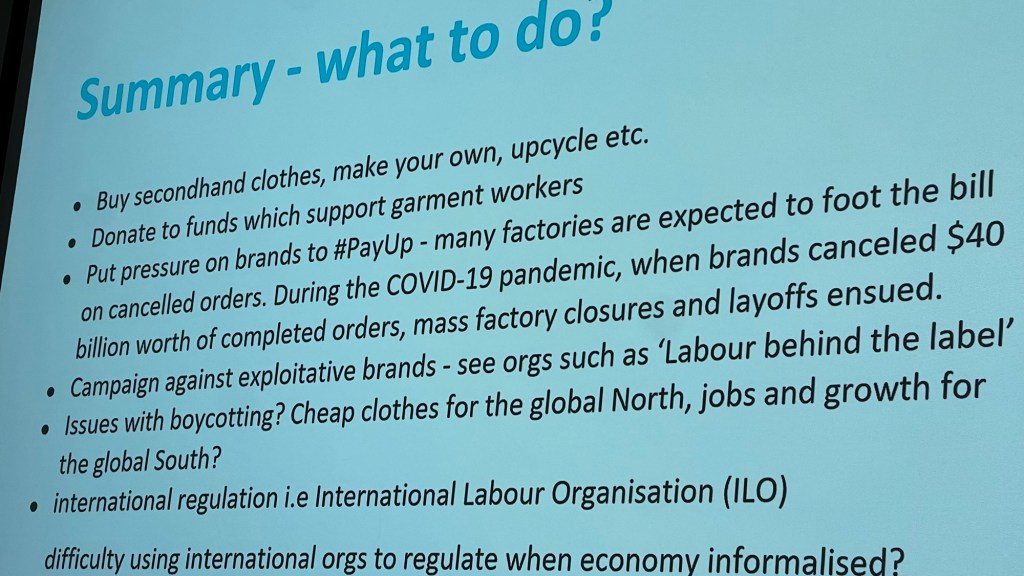
But what can we do ourselves ?
In a throwaway culture, it’s a radical act to think about endings. Yet in doing so, we discover new beginnings: materials reborn, creativity renewed, and a deeper harmony with the earth that sustains us.
As the day came to a close, we gathered to reflect on what we’d learned — and what we might do differently. Around tables scattered with embroidery threads and notebooks, participants shared their makes from the day and their personal sustainability pledges. I felt inspired and uplifted, the atmosphere was one of quiet hope — a reminder that change begins not in distant factories or boardrooms, but in our own wardrobes, hands, and hearts.
 Joy in Enough
Please may I have a copy of the talks – they sound fascinating!! Susan Cash ________________________________
LikeLike