

As COP 30 approaches, here is part 3 of a serialised article recollecting the Camino To COP I was part of in the run up to COP26 in 2021, to inspire us in our endeavours.
The COP26 conference in Glasgow came at a critical time for the world, when commitments were needed to half COz emissions by 2030. It was hoped that the weight of the hopes and dreams represented by patchwork pilgrimage of the Coat of Hopes would be a way of encouraging and inspiring world leaders and delegates to do the right thing at the conference.
Almost to the day four years ago I arrived in Blantyre with the Camino walkers.
And – it was raining.
Rain was to become very familiar to me during my time in Scotland. The rain in Scotland is like the rain in England, only more so. Firstly: there is literally more rain – it rains more frequently, and for longer. Secondly: the rain in Scotland is somehow more wet. The feeling of deep-down dampness engendered by Scottish rain somehow exceeds that of lily-livered English rain, which merely gets you mildly and temporarily wet by comparison.
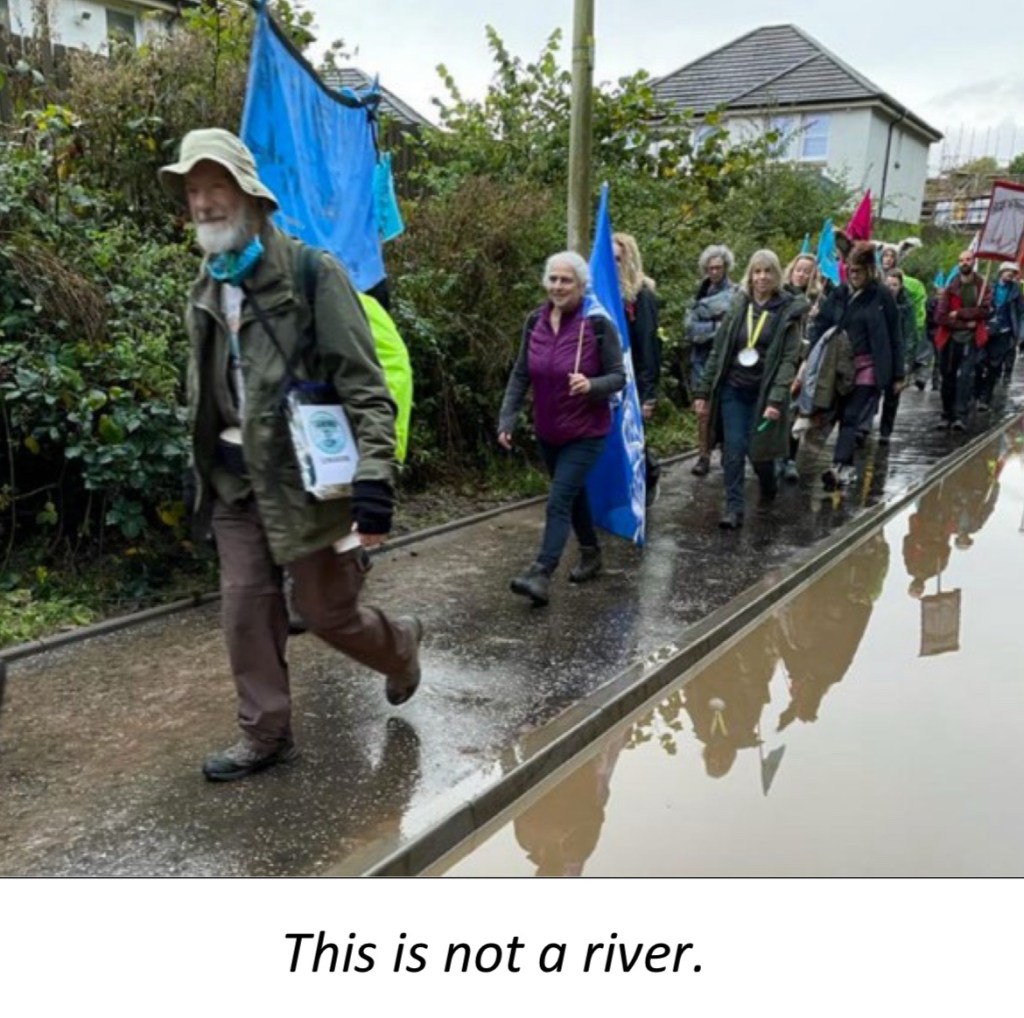
This is one of the many ways I was to discover in which life in Scotland is different from that in England.
Another I was to notice very rapidly is that shopkeepers are much nicer to you in Scotland, at least around the Glasgow area. As soon as you take but a single footstep within their stores they spontaneously and pre-emptively ask you if there is anything they can do for you — or if they can find is something that you need. I have never known an English shopkeeper, unsolicited, to ask if it would be helpful for them to look after your shopping behind the counter while you go about your other business. But this very thing happened to me on the Camino in Strathaven where, after a particularly rainy, wet and damp morning, I visited a general supplies store to stock up on such necessaries as waterproof trousers as well as a rather fetching red woollen scarf – along with, most significantly, a small, yet powerful, convection heater, which proved surprisingly successful in drying out the campervan floor, which had been somewhat water logged by the water tank overflowing on the way up to Glasgow.
Be warned, however, that, no matter what anyone tells you, the health systems in England and Scotland are compatible in only the most limited sense. My surgery administrator at home said it would be ‘no problem’ having a prescription sent up to a Scottish pharmacy.
She was wrong. Very wrong. Although they have the same name – ‘the NHS’ – it turns out that there are two different NHSes, one for England and one for Scotland.
Who knew!
Well, now, you. So don’t say I didn’t warn you next time you leave England for Scotland without a plentiful supply of your essential drugs.
Every cloud has a silver lining, however – even Scottish clouds. And the advantage of my wild-goose chase around various Scottish pharmacies, and eventually a surgery, trying to precure (legal) drugs, was that I managed to avoid spending that much time walking in the rain: for as soon as I eventually received my shiny red analgesics, the Scottish sun burst forth from behind the grey Glaswegian firmament and I was able to join the others and walk the remaining miles to Blantyre becoming only slightly damper in a mild drizzle.
Blantyre working men’s club
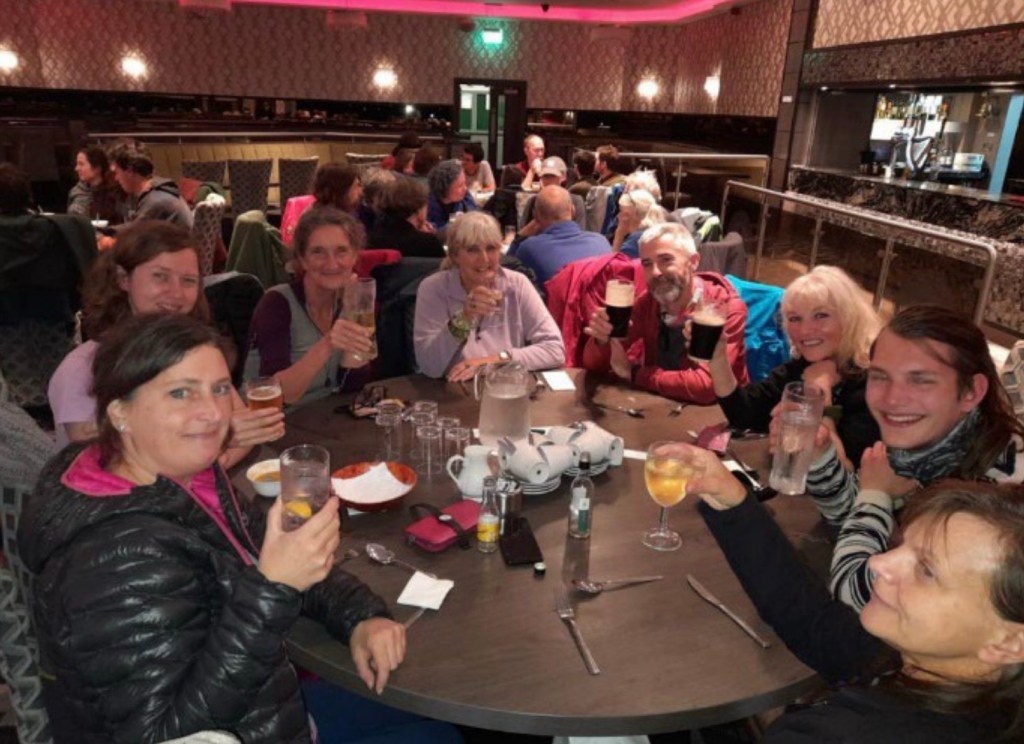
That evening I had a fascinating time with many other pilgrims in a Blantyre working men’s club – not just those on the Camino, but also another English group, who had walked much further each day, enabled by staying in booked accommodation without packs. Another group joined us who had walked all the way from Spain!
At the club we received the generous hospitality of our hosts St Joseph’s, Blantyre, who provided us with a free drink, and free curry! The club was for former miners, Blantyre being the site of a famous colliery where there was a dreadful explosion on 22 October 1877 that killed more than 200 men and boys. The club was a big source of support for miners and their families during the miners’ strike in 1980s. However the colliery could not be saved from closure, leaving Blantyre as place of high deprivation, with no other major industry to replace coal mining.

And so we returned to St Joseph’s keenly anticipating the final day’s march into Glasgow. This was to be an amazing confluence of influencers, a pilgrimage of pilgrimages, and the culmination of the Camino to COP.
It also involved me getting up at 6:30am, for a 7am start. For those not in the know, I am not a morning person. And sleeping in an over-cramped and still slightly damp campervan was not conducive to a particularly good night’s sleep.
Nonetheless, spurred by the magnitude and urgency of the occasion, I managed to crawl out from under my duvet (I’m not a huge fan of sleeping bags – I find them too confining) and into what I was grateful was only a fairly mild Glaswegian drizzle, at around this hideously early time.
In a daze of tiredness and confusion, yet also with a slightly manic euphoria, I joined the assembled throng at the front of St Joseph’s Hall.
Vicar Helen Burnett led us in a beautiful interfaith ceremony commemorating the last day of the Camino, and with another rendition of the Coat of Hopes song for good measure we set off in a column of vast number, our various pilgrimages intermingling and intertwining as we walked – nay, marched – at a fair clip away from Blantyre and St Joseph’s RC Church and into the Glaswegian hinterland, through the narrow band of green countryside separating the two.

Assembly ceremony outside the church
Other pilgrims had also joined us, for the last day’s march, and I found myself talking to an older couple I didn’t know from Norton St Phillip, near Bath. Norton St Phillip is a lovely little Somerset village where another older couple, Barbara and Tony, I know live. They are the parents of a university friend I know, and her siblings, whom I came to know.
It turned out this other couple knew Barbara and Tony! It’s a small world. Perhaps especially when you’re from Norton St Phillip…
 Joy in Enough