

Here is part 4 of a serialised article recollecting the Camino To COP I was part of in the run up to COP26 in 2021, to inspire us in our endeavours as activists.
The COP26 conference in Glasgow came at a critical time for the world, when commitments were needed to half COz emissions by 2030. It was hoped that the weight of the hopes and dreams represented by patchwork pilgrimage of the Coat of Hopes and Camino2Cop would be a way of encouraging and inspiring world leaders and delegates to do the right thing at the conference.
…The whole experience was quite overwhelming. And also strangely sad and moving. On trees around the edge of Glasgow Green, local XR activists had planted flags to symbolise the nations of the world most affected by global warming, but with least voice in decision-making.
The effect of the flags, the autumnal colours, long shadows, crisp air and clear light with the police standing silently among them gave the occasion a solemnity, and almost funereal air, in contrast to the vibrancy and excitement of the media presence, and intense positive emotion and energy of the newly-arrived activists.
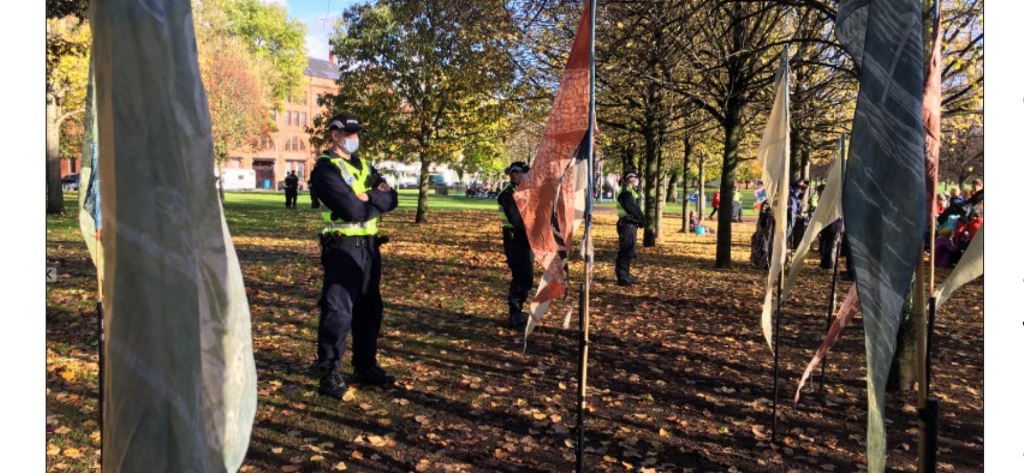
It was at this point that I became aware of the astonishing police presence in Glasgow. There were police, police, police everywhere you looked. And not all of them seemed like they had all that much to do, apart from looking menacing by gruffly folding their arms. It felt sometimes as if half the local forces in the country had been squeezed into one average-sized city. (The petty criminals of the UK must have been having a Queen’s birthday jubilee of thievery).
Police vans were on every street corner. And the ominous sound of the police helicopter was omnipresent, an unceasing drone overhead. My impression of the police was mixed. Some of them, like the Scottish police we talked to on the Green, couldn’t have been more polite, and agreed with our cause to an extent. Others from across the UK had the reputation of being more heavy-handed, like those who kettled protestors for hours after an officer got sprayed with washable green paint. Perhaps this was a case of good cop, bad cop writ large!
I had my own scary police experience. They tried to get inside my van twice while I was in it, one time in the middle of the night. Bravely, each time, I hid in the back. And they eventually went away.
That evening we made the local and national news in a big way. Several of the Caministas gave interviews, and our message, journey and purpose came across loud and clear.

But what I hadn’t realised when we’d set out that morning was that – after only a short break – the Camino walkers would be forming part of much a larger protest march to St George’s Square in the centre of Glasgow. It had been decided that the coat should be near the head of the protest march. And so I found myself being formed into a line near the front of the procession and squeezed behind a banner we had brought along with us on which ‘COP26 Walk The Talk’ was emblazoned – still without entirely realising exactly what was happening. This was quite alarming, but at the same time it felt exciting and daring.
Shortly after we set off some of us were interviewed by Sky News Scotland, including me. ‘What was Extinction Rebellion’s approach going to be in Glasgow?!’ the interview asked me, challengingly.
Possibly because I was wearing a large ‘hourglass’ medallion, one of the symbols associated with XR, he’d taken me to be a ringleader. (For the record, I don’t normally wear this particular medallion – just on special occasions.) I honestly had very little idea what XR’s approach in Glasgow was going to be, but I remembered hearing someone being interviewed on the radio saying they were aiming for ‘subtle yet persuasive tactics’.
‘I think we’re aiming for subtle yet persuasive tactics in Glasgow,’ I told the interviewer (I hope convincingly).
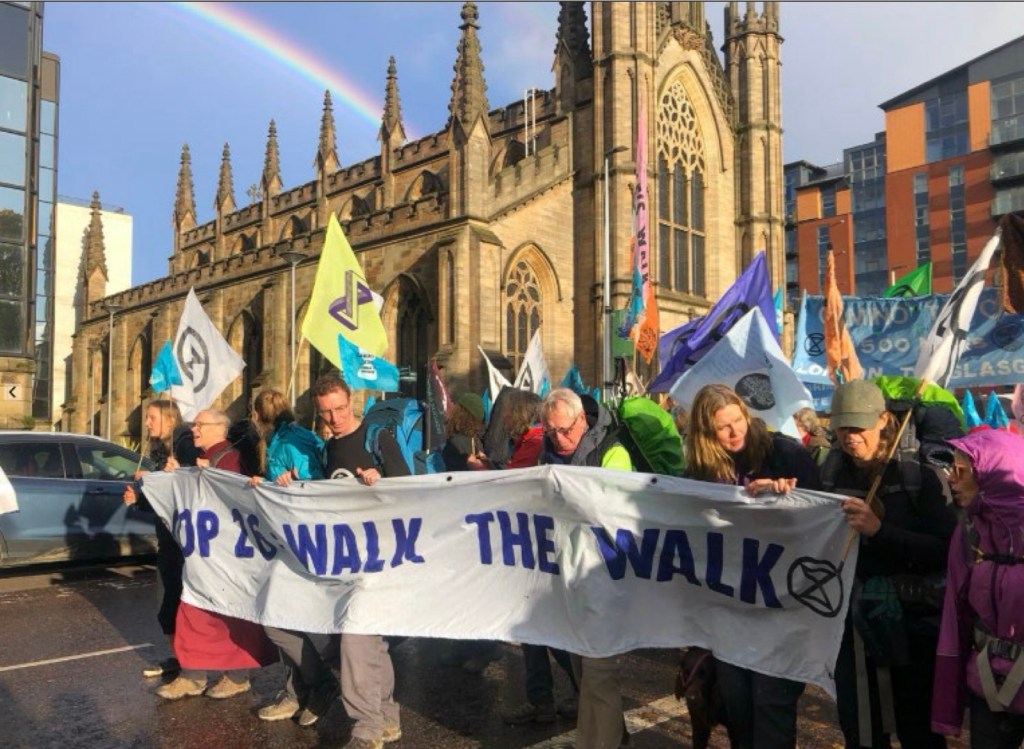
There followed a two-hour march into Glasgow, with drums, chanting and singing, a rapturous rainbow blur of colour, signs and sounds, our marching and chanting intermingling with the first glimpses of Glasgow’s spectacular Gothic Victorian architecture (beautifully captured by Ben Wigley’s recent film, debuted recently at the Encounters Film Festival in Bristol, at which I felt very blessed to be present).
For some, this was a Palm Sunday experience. A triumphal march into Glasgow, post-Camino, followed by the heartbreaking disappointment of the actual depressing, dismal reality of the results of COP26. This sense of disappointment was shared by many of the delegates from the majority world who were often shut out of the conference negotiations both figuratively and literally.
Lingering Covid restrictions (much more of a concern in Scotland than in England at the time) and strict security measures meant that it could take half an hour or more to negotiate the gates to the Blue Zone. Within the conference itself, I’ve read, the main negotiating floor was off limits to many majority world delegates. There were, apparently, more lobbyists from the oil and gas industry than delegates. And in Glasgow, accommodation was scarce. For a majority world delegate who had flown halfway across the world to be there, with English as a foreign language, this must have all been extremely challenging to navigate, to say the least.
For these delegates, especially those from low-lying island nations, the failure at COP26 to getcommitments to keep warming to below 1.5°C must have been especially galling, as well as the continuing failure to secure $100 billion climate finance from rich countries to ameliorate the effects of ‘loss and damage’. (‘Loss and damage’ is the technical term for the destructive consequences of global warming upon countries that have done least to cause it. The fund is meant to compensate them.)

And yet at the same time, there WAS welcome for outsiders in Glasgow, in the conference fringe and activist contingent who were there in Glasgow, in as much force as the police. One particular venue I frequented regularly with other activists was the Climate Café in Adelaide’s. This was an inspiring and inclusive space that featured regular interviews, music and conversation, with activists from all over the world…
 Joy in Enough