
Here is the final part of a serialised article recollecting the Camino To COP I was part of in the run up to COP26 in 2021, to inspire us in our endeavours as activists.
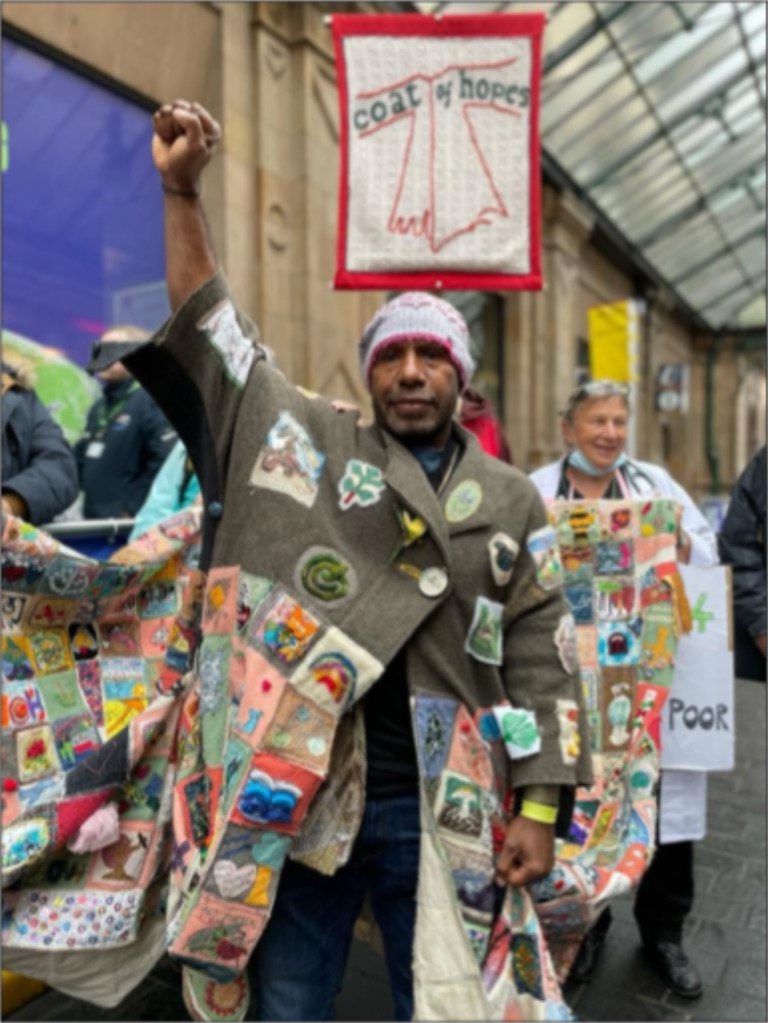
The COP26 conference in Glasgow came at a critical time for the world, when commitments were needed to half COz emissions by 2030. It was hoped that the weight of the hopes and dreams represented by patchwork pilgrimage of the Coat of Hopes and Camino2Cop would be a way of encouraging and inspiring world leaders and delegates to do the right thing at the conference.
The Coat of Hopes itself became also, in its own unique way, a place of welcome for delegates from across the majority world. It became more of a place of solace and empowerment for those marginalised by the conference than a challenge for leaders and lobbyists. They were mainly inaccessible, hidden in luxury limousines with galvanised glass that sped to and from the Blue Zone, and then cocooned within glazed lounges behind security fences. The warmth of the coat’s message from the many hands that stitched it together was one of solidarity, and many of the delegates who wore it, and had the coat song sung over them, testified to its uplifting and empowering effect. But this could be seen also in the tranquillity of the faces of those wearers without English.
Back home in Birmingham
couple of weeks after the conference, back in Birmingham, I heard a local Imam speak at Birmingham climate coalition. As a member of an interfaith delegation he was one of the lucky few able to access the Blue Zone. He spoke of the delays and difficulties getting in and out of the conference, and frustrations for delegations within the conference itself. But he said he was also fortunate enough to spend time as part of the conference fringe festival. He said that, for him, there were two starkly contrasting COP26s: the dull, corporatised UN conference, and the vibrant COP26 coalition event.
This reminds me of the introduction to A Tale of Two Cities:
‘It was the best of times, it was the worst of times, it was the age of wisdom, it was the age of foolishness, it was the epoch of belief, it was the epoch of incredulity, it was the season of Light, it was the season of Darkness, it was the spring of hope, it was the winter of despair.’
As I said recently when interviewed for the Methodist Action Stations podcast, if I hadn’t been to COP26 but simply watched it on TV, I would have felt profoundly depressed about the prospects for the world responding robustly to the climate crisis.
But if I had stayed at home, I would only have seen half the picture.
There IS complacency and delay due to corporate collusion with, and corruption among, our political leaders, but alongside and at the same time as that, huge innovation in all spheres of our economy, the way we produce energy, food and many potential revolutions reworking the underpinnings of our material culture.
Worldwide networks of activists such as Extinction Rebellion, Avaaz and Fridays for Future, holding oil companies’ and governments’ feet to the fire, give hope that at some point in the future oil production will become socially unacceptable and, perhaps more importantly, economically untenable, as financial flows shift away from the stranded assets of oil production.
But isn’t this something that needs to happen in the next five to 10 years? My understanding is that this of a mischaracterisation of the science. As the climate scientist Michael E Mann writes in his recent book The New Climate War, there is ‘urgency, but also agency’.
The climate crisis is already here, now.
Crisis comes from a Greek word, meaning a time of reckoning, decision and discernment.
Especially in the global south, the climate crisis’ effects are increasingly felt in extreme weather events, fires, floods and drought. But with that same urgency comes the agency that everything we can do to hold the overall average temperature rise down by 0.1° is worth doing. We are not so much in a race against time to prevent a cascade of catastrophic tipping points, Mann says, analogous to a ball rolling down an ever-steepening slope to a cliff edge, but by risking further temperature increases it is more as if we are stepping out further into an uncharted minefield. With every fraction of a degree rise, there is more energy in the climate system. With more energy in the climate system come greater, and increasingly chaotic, weather effects.
What this means in practical terms is that we are living in a time, similar in some ways to other times of crisis such as WWIl, when our actions can make a real difference to the future of the world. This could be something to shy away from, but it could also be something to feel excited about.
It is for each of us to decide what is we are able and willing to do in this time of crisis. I decided to go to Glasgow, because it was something it was within my capacity to do (just about!).
But I could have easily just stayed at home.
I’m glad that I didn’t.
By Damian J. Hursey
Next – bringing things up to date – a reflection on the reflection in the light of COP 30.
 Joy in Enough