
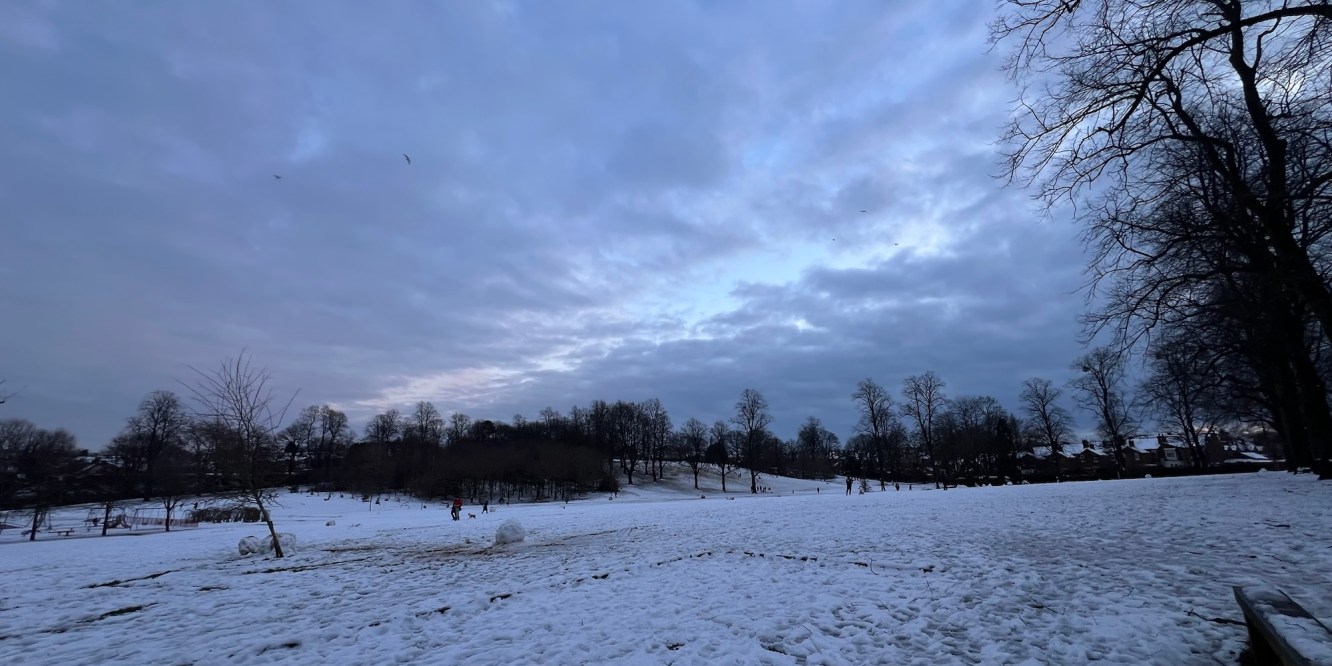
Following my article on the Joy of Sledging, and anticipating more (yet sadly never appearing) snow this weekend. I hope you can forgive my bowdlerisation of Blake’s classic ‘Jerusalem’ in the title for this article.
But I suspect that, in reality, if the poem refers to Jesus rather than Joseph of Arimathea, he is no more likely to have skated, or sledged, upon England’s lakes and mountains than walked upon them, in ancient time.
Although, intriguingly, there is a slight possibility that Jesus could have sledged in ancient Palestine. The climate in the First Century seems to have been somewhat less dry than today’s, when higher altitudes near Jerusalem and Bethlehem could even see snow, though it was rare and limited to brief periods during December and January.
Accordingly, the very first Christmas may even have been white, at least for the shepherds up in the hills around Bethlehem. Perhaps it was them who sledged, skated, or skiied, down to see the saviour, over-joyed at the prospect of seeing the new born child.
Meanwhile, in the first century, snow in Britain was in all likelihood far more plentiful than today. In AD 50 there is recorded an extended winter when all rivers froze from November to April.
Even allowing for this being a particularly cold winter, such an event in the U.K. is inconceivable in modern times. Although between 1400-1850 the infamous Mini-Ice Age could freeze the Thames over for famous Frost Fairs, for up to two months, this was partly due to the medieval bridge, where blocks of ice would stick in the narrow bridge arches and allow the river to freeze more easily.
More alarmingly, since 1850, owing to industrialisation and its associated carbon dioxide emissions (a.k.a global warming), the number of snow days has steadily, though irregularly, reduced. The average temperature is now 1.2 degrees greater than in pre-industrial times and whereas the average temperature in the 1890s during December was 3.1C, during the 2010s it was a much warmer, but still chilly, 4.8C. So if the holy feet did indeed tread upon England’s mountains in ancient time, they may have been more liable to slip!
Why am I speculating somewhat irreverently upon the possibility of the saviour sledging? Firstly, to highlight changing weather patterns, and that, although it may not feel like it (especially today – brrrr!) the climate of this country is definitively getting warmer. In fact in researching this article I discovered the disconcerting truth that some scientists think that by the end of the century there may be no snow fall whatsoever in the British Isles.
Like a friend who told me how saddened she was when she learned that in 40 years time, no more nightingales would come to the UK due to their changing migration patterns, this is the sort of sobering truth about the sorts of changes climate change will bring about that brings us up short, and sharply reminds us of the radical shifts in what we consider to be normality we are creating that we may not desire or intend.
No more nightingales.
No more snow.
No more building snowmen.
No more sledging.
Secondly, as a corollary, snow and ice, though disruptive, also bring with them a host of cultural and historical associations and associated activities, to do with pleasure, celebration, happiness and joy.
The vividness, suddenness and starkly contrasting nature of snow scenes, compared to otherwise cold and grey weather, leave an edible imprint on the memory, creating a sense of nostalgia, and a shared cultural moment, like a home made black and white film from the 1940s I saw on Tuesday, of factory workers skating on a frozen section of Cadbury cricket ground.
I would like to think Jesus was the type of person that would enjoy those sorts of activities and be someone who fully participated in them. Because at Joy in Enough we ask ourselves and others the question, ‘what does a life filled with joyful activity look like?’
Perhaps, reflecting upon what activities the ancient hands and feet would have enjoyed and participated in might provide part of the answer.
By Damian J. Hursey
 Joy in Enough
But if the AMOC fails, we’ll have plenty of ice in the winter when temperatures drop to -20C but not much precipitation I think.
LikeLike