

By Mark Dick
Jubilee Co-operative Farm, above the River Glynn, is only 25 miles from Lough Neagh – the ‘gap’ in the middle of Northern Island and the largest fresh Water lake in the UK. But the farm and Lough Neagh are worlds apart in that they represent opposite ends of the agricultural spectrum in terms of intensive farming, and they are a microcosm of why the modern industrial agricultural system needs to change. Intensive farming, in order to maximise profits, is a major contributing factor to the cyanobacterial crisis in Lough Neagh that started to take hold in 2023. Yet the low intensity regenerative food production at nearby Jubilee Farm just does not pay its way.

Lough Neagh 2019

Lough Neagh Today
Historically, the people of Northern Ireland love someone to blame! Should the farmers be blamed for the excessive amounts of slurry and chemicals that run off the land into watercourses? Should the pig and chicken production units be blamed for their waste flooding into rivers? Should Northern Ireland Water Service take the blame for untreated sewage making it way to Lough Neagh via the six major rivers which enter the Lough? Perhaps the supermarkets should take some of the blame for driving the profit margins for farmers so low. But what about ourselves? We all demand cheap food, of all possible types, from all possible sources, all year around. It is now becoming obvious that this unseasonal cheap food is an unsustainable product of modern neoliberal capitalism. The market is blind to the ecological consequences of the current agri-business system.
So, what is to be done? Should we embrace Chris Smaje’s small scale ecological agrarian localism and turn away from any form of eco-modernism (Saying No to a Farm-Free Future). He totally rejects George Monbiot’s willingness to entertain technological solutions such as precision fermentation (Regenesis). However, Monbiot cannot see how there will be enough land to carry out rewilding as well as accommodate the number of small farms needed to feed megacities.
A quick look at this chart would suggest that everyone should shift to a mainly plant based diet.
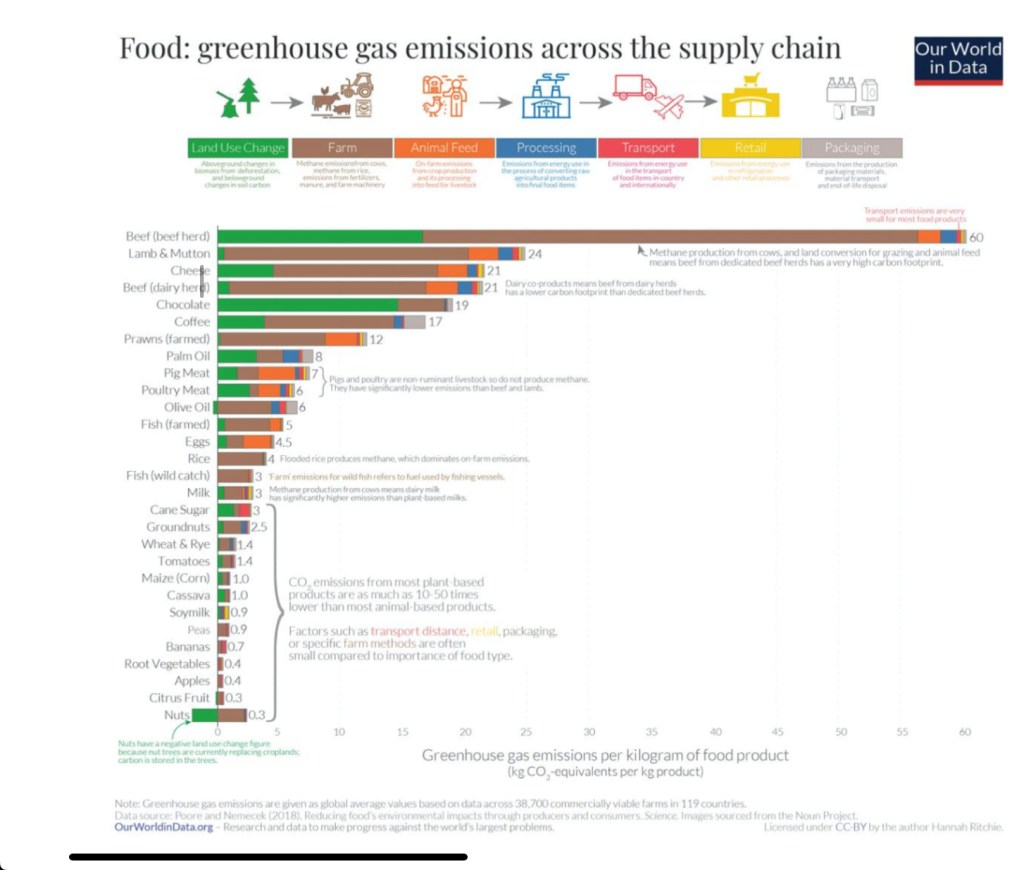
If eating meat once a month became the norm then theoretically, we could reduce all
livestock (cattle, pigs, chicken, sheep) by 90% especially in the Global North, but
also in the Global South to restart afforestation both by removing the animals and
avoiding the planting of soya for animal feed.
But where is the compensation coming from for a JUST transition? This is where it
becomes impossible to avoid system thinking because of the intersectionality of
issues and how everything is connected. Massive sums of money will be required for
“loss and damage” and reparations towards the Global South, as well as for a just
transition for farmers and fossil fuel industry workers in the Global North.
There is a middle ground to be found between George Monbiot and Chris Smaje. I
do not view Monbiot as an out and out eco-modernist nor Smaje as a Dark Mountain
zealot. There must be some land set aside for rewilding (Regenesis)
if only to partly reverse insectageddon. In The Insect Crisis, Oliver Milman clearly
outlines our fragile dependence on the planet’s smallest creatures. The world is
literally unimaginable without the insects that make it work. We must understand that
the top of the food chain is a happy place to be only so long as there remains a food
chain to stand on top of.
Equally, locally sourced and fairly traded, regeneratively produced food in season
(Saying No to a Farm-Free Future) will go a long way to reverse Carbon Colonialism
(Laurie Parsons) if it is subsided properly by those with the broadest shoulders.
Consequently, a global progressive wealth tax is necessary to fund all this; and also
to fund a global universal income to enable the Global South to leapfrog the fossil
fuel stage of development straight to sustainable energy, industry and agriculture. As
the whole world must move in this direction together, we need a new system of
global cooperation, deliberation and decision making i.e. global governance.
I would suggest that a world parliament (one person, one vote) is better than the current United Nations (one government, one vote) or rule by the current transnational corporate elite (one dollar, one vote).
Paul Kunert (Jesus Died To Save The Planet) feels that many Christians struggle
with this assessment. ‘From Genesis to Revelation, we see that God’s plan is the
flourishing of the earth, not its destruction. God’s first affirmation is that the earth is
good. At the outset, even before God made humankind, everything he made – the
land and the seas, vegetation, the fish of the sea, the birds of the air, and every living
thing that moves upon the earth – was good….. This wouldn’t need elaboration if
Christians weren’t so deeply influenced by the idea that matter doesn’t really matter.
But God’s message is that the world, this material world, is good …. It is the
‘elemental spiritual forces’ we are warned about in Colossians 2:8 that are to be
dissolved with fire, not the entire earth.’ The earth is purged, not destroyed, just as
the church itself is tested by fire (1 Corinthians 3:10–15), but not destroyed.
Still, I’ve heard more than one evangelistic sermon along the lines of, ‘The ship is
sinking. Get in the lifeboat before it’s too late.’ Put, bluntly, that’s not the biblical
picture. The consistent biblical picture is not of being rescued from here and taken
somewhere else:
Biblically, there is no lifeboat. Just this ship. And the promise that, despite how it’s all
looking, it’ll have a full refit and be as good as – no, better than – new. We must do
away with the lifeboat picture and start talking about God’s plan for the renewal of
the ship (Paul Kunert)
There is no planet B, but there is a plan B.
Mark Dick
JiE
 Joy in Enough
I don’t often comment as it takes much thinking to really understand how we can get humankind to put down their weapons, their greed for more, and live more simply more sustainably. Too many people just don’t get it. We have to take action, we can’t wait for governments to fix it for us. But then poverty throughs a spanner in the works. I do not know how it can be resolved but just try to live as sustainably as possible myself. Grow and eat seasonally, mend and make do, walk, cycle and use public transport, don’t buy unless I really need it, and the elephant in the room, stop population increasing so quickly. Kathy
LikeLike