
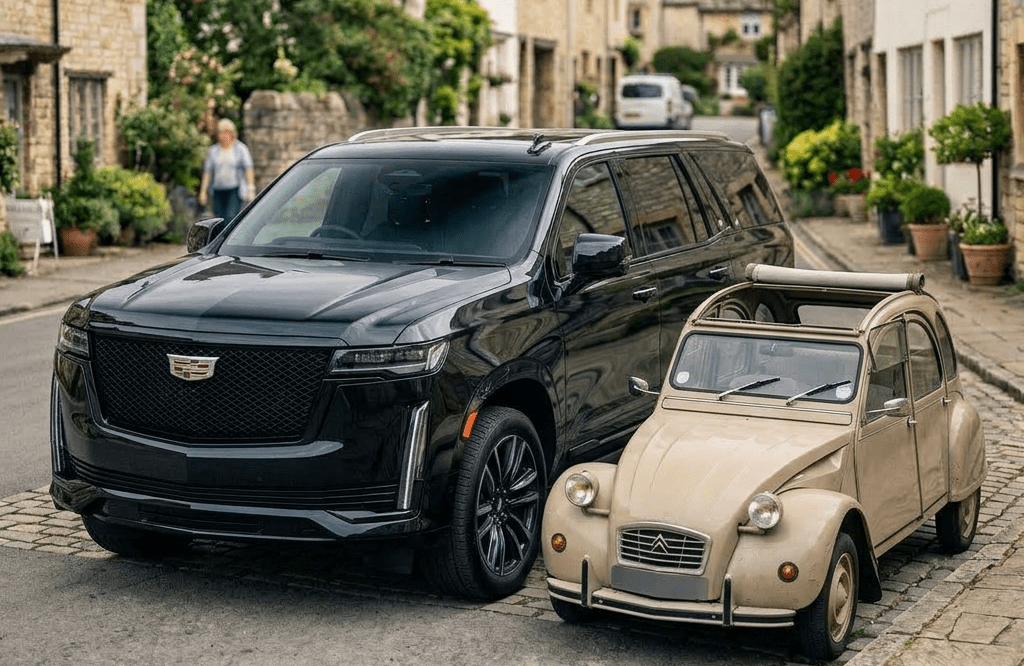
In my article on May 9th, I wrote about how the ‘alignment problem’ is not a distant AI nightmare – we have already built institutions—most notably the modern corporation —that behave like misaligned artificial intelligence, relentlessly optimizing for profit while treating human and planetary well being as a ‘nice to have’ afterthought.
But there is a tangible, everyday example of this type that type of misalignment – the rise of the SUV. At the very moment when environmental necessity demanded smaller, lighter, more efficient cars, the profit motive has flooded our roads with massive American-style SUVs – and even the shift to electric vehicles has not eliminated the problem.
The Profit Imperative
As I noted in my earlier piece, capitalism’s defining feature is the profit motive. Automakers, like all corporations, prioritise what generates the highest returns for shareholders. It may sound like a conspiracy, but though cartels and such like, may have conspiratorial elements – the misaligned outcomes are largely down the incentives of the dominant system. And it’s precisely those systems of capital accumulation that have created the SUV as object of consumer desire.
Because automakers can charge a premium while using largely the same components, an SUV generates 20–25% higher profit margins than a small car. According to J.D. Power, for example, SUVs make up only 15% of auto sales but deliver 60% of industry profits. In India, SUVs now command 65% of the passenger vehicle market, with manufacturers openly admitting they are ‘focusing on SUVs which offer better profit margins.’ This is the profit motive in its purest form—competent, relentless, ubiquitously profligate and profoundly misaligned with what the planet needs.
A Regulatory Framework Rewarding Failure
Compounding the problem is a regulatory architecture that actively incentivizes larger vehicles. The US ‘light truck loophole’ in CAFE standards is a monument to misalignment.
Originally intended for genuine work vehicles, it allowed SUVs to be classified as light trucks, subject to far weaker fuel economy targets: 20.7 miles per gallon versus 27.5 mpg for passenger cars. Automakers exploited this gap deliberately, and some have now stopped making cars altogether. The perverse incentive could not be clearer: the less efficient the vehicle, the more profitable it became to produce.
The Environmental Fallout
The consequences have arrived at the worst possible moment. The International Energy Agency calculates that the average SUV consumes 20% more fuel and emits 20% more CO2 than a medium-sized car. The global SUV fleet, if it were a country, would be the world’s fifth-largest emitter, surpassing Japan, Germany, and South Korea. Over the last decade, SUVs were the only area of energy-related emissions growth in advanced economies, adding 300 million tonnes of CO2. In the US, SUVs and trucks accounted for roughly 60% of new vehicles in 2024. In Europe, SUV market share exploded from 41% in 2020 to 59% in 2025. The small car is being systematically erased.
The Electric SUV Paradox: Bigger Batteries, Bigger Problems
When electric vehicles arrived, I hoped they might break this cycle. Instead, the profit motive simply migrated to the new technology. Automakers quickly realised that electric SUVs are even more lucrative than petrol ones—and dramatically more resource-intensive.
The core issue is the battery. An electric hatchback typically uses a 40–60 kWh battery. An electric SUV, due to its larger frame, higher weight, and poorer aerodynamics, requires 80–100 kWh or more to achieve a competitive range. Scale effects abound: the Tesla Model 3 (hatchback) uses 50–82 kWh; the Model X (SUV) starts at 100 kWh. The Ford Mustang Mach-E SUV uses up to 98 kWh; the smaller Ford Fiesta Electric used only 42 kWh before it was discontinued. We are talking about a near-doubling of battery capacity per vehicle.
The resource implications are staggering. Producing one 100 kWh SUV battery requires roughly 500–750 kg of lithium, nickel, cobalt, and graphite, plus tens of thousands of litres of water. An electric SUV therefore has an embedded CO2 footprint 35–50% higher than an ordinary car before it ever leaves the factory. And because it is heavier and less aerodynamic, it consumes more electricity per mile, depending on the mix from the grid as to how renewable the electricity generation is. How can this make any sense when smaller cars, (whether electric or petrol) use so much less energy, create fewer C02 emissions and take up less space on the roads?
Yet the profit motive makes this misalignment inevitable. Larger batteries allow automakers to charge $20,000 more for an electric SUV, while the extra battery capacity adds only $5,000 to manufacturing costs. The result is gross margins exceeding 25% on electric SUVs, compared to near-break-even margins on small electric cars. Consequently, Ford has halted production of its small fleet-oriented EV models. GM killed the affordable Chevrolet Bolt while launching nine new electric SUVs. The market is following the money, not the climate.
Beyond CO2: The Hidden Costs in Human Blood
The dangers are not only atmospheric. The high, blunt front ends of SUVs are lethal for pedestrians and cyclists. In the U.S. an IIHS study of nearly 18,000 crashes found that vehicles with a hood height above 40 inches are 45% more likely to cause a fatality in a pedestrian crash than lower, sloped vehicles. At higher speeds, the fatality rate approaches 100%. These are not unfortunate side effects; they are predictable outcomes of a system optimising for profit margins – thereby primed to exploit regulatory loopholes.
The Paperclip Maximizer on Wheels
The hypothetical paperclip-maximizing AI does not destroy the world not because it is evil, but because it is relentlessly competent at optimising the wrong thing. The modern corporation behaves exactly the same way. It does not hate the planet; it simply does not value a habitable planet unless doing so serves its ‘primary directive.’
Thus at the very moment when climate science demands smaller, lighter, more efficient vehicles—including smaller, more efficient electric vehicles—the machinery of capitalism has delivered the opposite: heavier, deadlier, and vastly more polluting machines, all in the name of quarterly returns. The original misalignment problem is not a dystopian AI scare story. It is a present reality, parked in many of our driveways.
By Damian J. Hursey
Others sources
Electric vehicle battery sizes
· Tesla Model 3 (sedan) – 60 to 82 kWh
https://simple.wikipedia.org/wiki/Tesla_Model_3
· Tesla Model X (SUV) – 100 kWh
https://simple.wikipedia.org/wiki/Tesla_Model_X
· Ford Mustang Mach‑E (SUV) – 75.7 to 98.8 kWh
https://en.wikipedia.org/wiki/Ford_Mustang_Mach-E
Ford F-150 Lightning discontinuation
Ford halts production of F‑150 Lightning electric pickup – NDTV, December 2025
GM kills Chevrolet Bolt and launches nine electric SUVs


Thank you for a useful article.
Might some of the solution lie with local authorities who can charge more for SUVs to park including for residents parking permits?
And equally with the government who really should be making the case for banning g such vehicles.
LikeLike