
The only account of Jacob and a well in the Old Testament is when Jacob is reunited with his uncle Laban and meets his future wife Rachel. This takes place to the east of the Jordon, where we see Jacob buying a plot of land near to the ancient Canaanite town of Shechem in Genesis 33. At the end of the Book of Joshua, we are told that Joseph’s bones were buried there. Maybe this is what is meant when it says Jacob gave the plot to his son Joseph at the beginning of John 4.
My friend, Mark Cuthbert, is an expert on groundwater. I asked him what he knows about groundwater in the north of the West Bank. The first fact he gave me was that Jacob’s Well is tapping water from the water-bearing rocks of the Jenin aquifer. Water flows underground through the porous aquifer rocks and emerges when it meets ground level, in springs. The water in the aquifers is replenished during the rainfall season, October to March.
Nablus, in a valley in the hill country, on the route of an ancient road between Judaea and Galilee, is an area that had many springs, as gravity brought the water down through the mountain aquifers and into the valley. This created beautiful fertile agricultural land for olive trees, vines, pomegranates, melons, almonds, vegetables, wheat and barley. In an area of many springs, people dig wells, so they can irrigate their crops, and water their flocks.
In an Eastern suburb, called Balata, in the city of Nablus, which is in the north of the West Bank, there is an Orthodox Church. There is a very old tradition that this church has been built on the site of Jacob’s Well, where in John 4, Jesus has a conversation with a Samaritan woman.
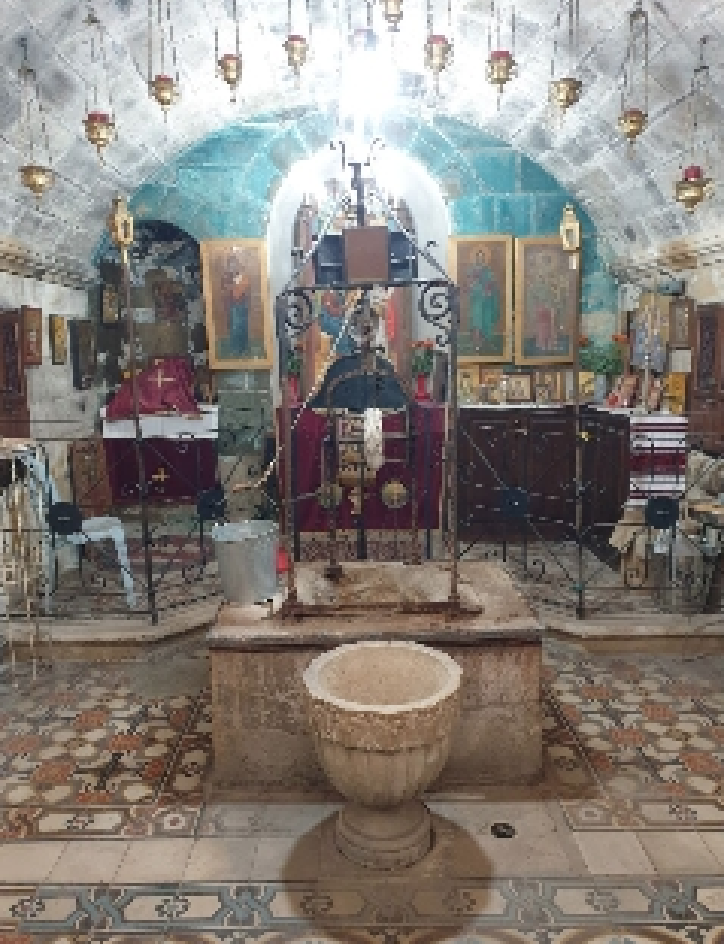
In the basement of the church there is indeed a well which I have had the privilege of visiting on two separate occasions. The church is dedicated to St Photini. Orthodox tradition has it that this was the name of the Samaritan woman, and that she became one of Jesus’s disciples. Her name comes from Greek roots meaning ‘light, or bright, or shining’.
As you look at my photo, you may feel that it is nothing like the scene you imagine as you read John ch 4. This is actually the experience of people who go on pilgrimage to the traditional sites of the New Testament stories – all the places where Jesus is said to have preached or performed miracles, have long since had churches built on them. This experience can leave the pilgrims feeling a bit flat, although the contours of the hills, the skies above and the Sea of Galilee are pretty much the same as in the time of Jesus – except the Sea of Galilee has shrunk somewhat.
The well is very deep. The priest of St Photini, Abuna (or Father) Ioustinos usually invites someone from a visitors’ group to throw a stone down, and it takes a while before we hear the splash. He then invites another group member to draw up some water from the well, which we are invited to taste. It’s a bit minerally. The ancient pulley system now used for drawing the water is very unlikely to bear any resemblance to the way the Samaritan woman drew water from the well.
Christian tradition, based on John 4, teaches that Jacob dug a well on this plot. It’s not entirely clear whether the Sychar of John 4 is the former Shechem, but the site of the church, in modern Balata Village is close to some archaeological discoveries that have been associated with Shechem. This is all now incorporated into the Palestinian city of Nablus.
An article Mark referred me to is a 2017 report by Amnesty International, which describes how since 1967, Israel has controlled and restricted Palestinians’ access to water.Meanwhile the Israeli settlements in the West Bank, illegal under international law, are provided with enough water for swimming pools and green lawns. The Israeli state-owned water company Mekorot is intercepting the water from the aquifers that fed the springs through this once fertile land. Mekorot pipes the water to the settlements and then sells some water to the Palestinian water utilities. It is never enough, and the Palestinians end up having to buy water at highly inflated prices, which is brought in by lorry.
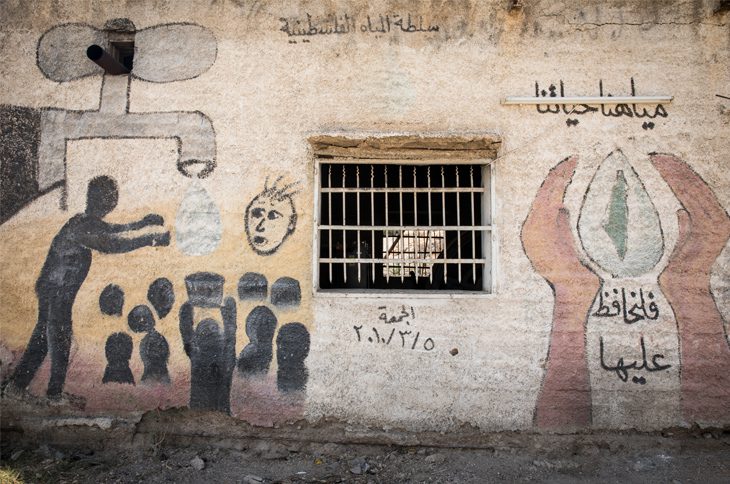
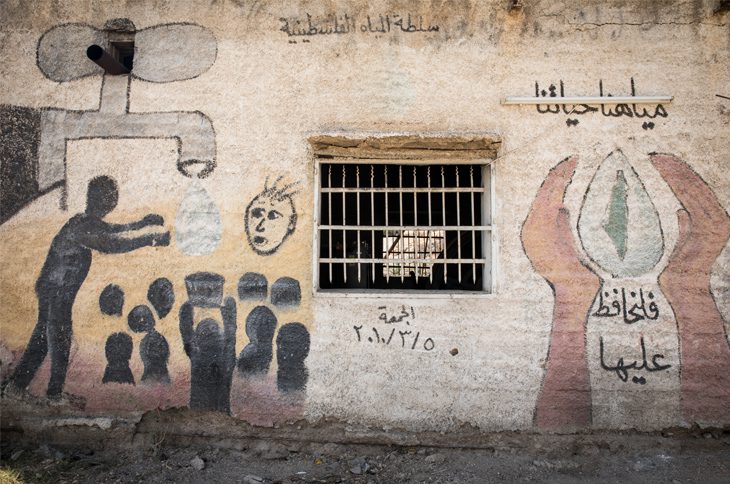
This picture, from the Amnesty Report shows a photograph of an old pumping station that has been abandoned due to the redirection of the water flow. The Arabic writing says ‘Our water is our life, so let’s preserve it’.
The way to distinguish a Palestinian home from an Israeli one is by whether there is a black or white water tank either on top of, or near to the home. The Israeli settlers, who are completely lawless and are engaged in ethnic cleansing of the Palestinians, have been known to shoot at the water tanks causing the precious stored water to drain away.
It is of great regret that the water situation in Nablus today is a much less happy one than at the time of Jesus.
Margaret Healey-Pollett, April 2026
 Joy in Enough
water shortages and unequal access to this common resource is widespread. Andrew Mayes gives more examples in his book Unlocking the Fountains: Inspiration and Challenge from Biblical Rivers and Springs, where he also explores stories and commentaries from scripture and from Christian writers. He draws attention to our misuse of water whether through using rivers as depositories for sewage and other pollutants, or by extracting at a faster rate than the water can be replenished – this latter due to inappropriate farming methods and crops, and excessive use by domestic and commercial customers.
In this country we are seeing real problems around the sustainable supply of water which is compounded by the economic model used to organise the supply. Private equity firms are, by nature, in the business of maximising profits. They are not motivated by concerns for the wellbeing of life that is dependent on water, nor for the wellbeing of the water supply itself. Nor are they interested in encouraging their consumers to consume less waste fully.
Looking ahead, our water supply system is probably not going to cope with the excessive demands that will likely be made by A1 data centres. This is an issue not just for the UK but for all other countries developing A1.
The supply of fresh water is one of the nine planetary boundaries that constrains life on Earth. It is limit we have already transgressed – ie globally we consume water at faster rate than it reserves can be replenished.
LikeLike